

Almas Kasymzhanov is an entrepreneur and analyst writing about marketplaces, technology and Central Asian economies. He also writes for Forbes Kazakhstan.
Every crisis has an instrument that notices it first. This time it isn’t Rosstat, or the filling station, or the television, but a marketplace warehouse.
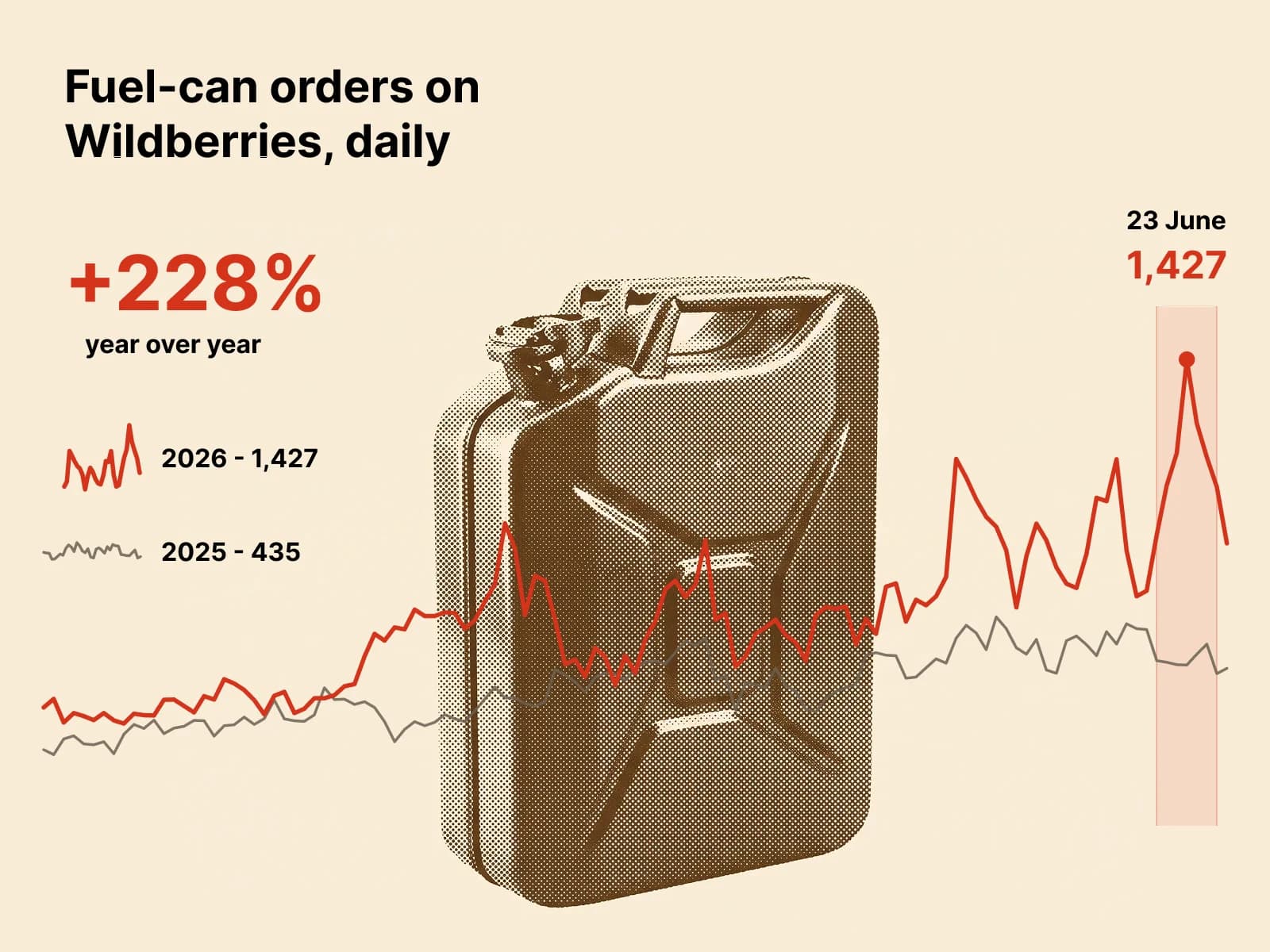
While the zeros lit up on the pump displays and officials called the queues a panic, the marketplace was logging what no one announces from a podium but everyone leaves in the order log. On 23 June 2026, in a single day, people there bought 1,427 jerrycans for fuel.1 A year earlier, on the very same day — 435.
A marketplace doesn’t comment or panic, and it reassures no one — it simply records what people are spending money on right now. And when the official statistics go dark, that log stays the country’s most honest gauge. The barometer the state forgot to ban.
There’s a Shortage. There’s No Counter
Summer 2026. A country that pumps oil is rationing fuel: “full tank only,” 30–40 litres per customer, no filling jerrycans — in no fewer than 56 regions.2 The cause isn’t in the ground but in the refining: a run of shutdowns at refineries cut gasoline output by roughly a quarter year on year by mid-June.3 The queues and the dark pump displays — everyone has written about those; we won’t repeat them.
The price shot where the regulator couldn’t reach: on Crimea’s black market a litre ran as high as 200 rubles — against 65–71 at the pump.4 What’s more interesting is what a person does after looking at that queue and deciding tomorrow will be worse. They go to stock up. And there’s nothing to stock up in, because selling fuel on the marketplace has been banned. So they buy what’s still allowed — empty cans.
And the country switched off its main instrument itself. As for monthly gasoline output, Rosstat stopped publishing it back in 2024.5 There’s a shortage — but no number for it. So it has to be measured indirectly, with the counter they forgot to switch off. I’m leaving politics and the front out of this — only what’s visible in a marketplace’s log once the official tally has been zeroed out. And there’s a lot to see there.
Why a Jerrycan, of All Things
A marketplace records millions of decisions a day, and almost every one is somebody’s small forecast about the future. Most goods make poor indicators: demand for generators is smeared by blackouts, for scooters by regulation. The jerrycan is clean. Nobody takes one to the dacha in winter or gives it as a gift — people buy it for fuel they’re afraid they won’t get.
And here it’s easy to mix up three different things that even the business press trips over. First: on the recommendation of FAS the marketplaces pulled fuel itself off the shelves as a product — Ozon, Wildberries and Avito have blocked such listings at moderation since 22 June.6 Second: some filling stations stopped pouring fuel into jerrycans. Third, which never happened: nobody banned empty jerrycans. They’re sold freely. The ban landed on fuel — and the demand spilled into the can, and the can became the storefront of the panic.
Reading a crisis by the jerrycan is no new trick. It was done in the US in 2021 and in Britain that same autumn. We’ll come back to them — they prove the instrument works.
The Curve the News Tickers Never Show
Here’s what a shortage looks like if you watch not the pump but the warehouse.
Per MPStats, from 1 March to 27 June 2026 the fuel-jerrycan category on Wildberries logged 69,978 orders worth 91 million rubles. Over the same stretch a year earlier — 43,057 orders worth 39 million. YoY demand grew 62 percent, revenue 134.
But the annual total hides the main thing — the shape of the curve. In mid-June the flat line steps up, and the step lands to the day on the fuel-sales ban of 20–22 June. On the 18th — 658 orders, +19% year on year. Then the run-up: the 20th — 857, the 21st — 1,018, the 22nd — 1,123. 23 June, the peak: 1,427 orders, +228 percent year on year and 4.7× the average March day. The ban didn’t kill demand; it poured it into the marketplace’s warehouse.
| X | 2026 | 2025 |
|---|---|---|
| Mar 1 | 297 | 160 |
| Mar 2 | 325 | 144 |
| Mar 3 | 248 | 195 |
| Mar 4 | 279 | 205 |
| Mar 5 | 269 | 179 |
| Mar 6 | 256 | 176 |
| Mar 7 | 279 | 186 |
| Mar 8 | 255 | 147 |
| Mar 9 | 245 | 210 |
| Mar 10 | 277 | 242 |
| Mar 11 | 272 | 229 |
| Mar 12 | 271 | 256 |
| Mar 13 | 322 | 212 |
| Mar 14 | 323 | 230 |
| Mar 15 | 302 | 236 |
| Mar 16 | 281 | 255 |
| Mar 17 | 334 | 254 |
| Mar 18 | 323 | 204 |
| Mar 19 | 389 | 238 |
| Mar 20 | 375 | 241 |
| Mar 21 | 354 | 266 |
| Mar 22 | 321 | 242 |
| Mar 23 | 275 | 261 |
| Mar 24 | 335 | 321 |
| Mar 25 | 348 | 260 |
| Mar 26 | 279 | 254 |
| Mar 27 | 293 | 252 |
| Mar 28 | 327 | 273 |
| Mar 29 | 327 | 361 |
| Mar 30 | 337 | 323 |
| Mar 31 | 366 | 324 |
| Apr 1 | 373 | 307 |
| Apr 2 | 463 | 316 |
| Apr 3 | 536 | 297 |
| Apr 4 | 514 | 251 |
| Apr 5 | 557 | 186 |
| Apr 6 | 551 | 226 |
| Apr 7 | 615 | 251 |
| Apr 8 | 594 | 238 |
| Apr 9 | 594 | 249 |
| Apr 10 | 606 | 274 |
| Apr 11 | 604 | 260 |
| Apr 12 | 553 | 251 |
| Apr 13 | 580 | 286 |
| Apr 14 | 641 | 325 |
| Apr 15 | 697 | 363 |
| Apr 16 | 895 | 328 |
| Apr 17 | 813 | 328 |
| Apr 18 | 597 | 310 |
| Apr 19 | 725 | 301 |
| Apr 20 | 708 | 316 |
| Apr 21 | 582 | 420 |
| Apr 22 | 437 | 403 |
| Apr 23 | 453 | 380 |
| Apr 24 | 397 | 348 |
| Apr 25 | 491 | 395 |
| Apr 26 | 461 | 409 |
| Apr 27 | 369 | 404 |
| Apr 28 | 465 | 385 |
| Apr 29 | 409 | 422 |
| Apr 30 | 519 | 445 |
| May 1 | 577 | 448 |
| May 2 | 681 | 438 |
| May 3 | 709 | 476 |
| May 4 | 656 | 513 |
| May 5 | 696 | 498 |
| May 6 | 840 | 522 |
| May 7 | 582 | 386 |
| May 8 | 604 | 399 |
| May 9 | 429 | 289 |
| May 10 | 463 | 379 |
| May 11 | 536 | 372 |
| May 12 | 557 | 361 |
| May 13 | 582 | 425 |
| May 14 | 532 | 368 |
| May 15 | 508 | 350 |
| May 16 | 449 | 291 |
| May 17 | 597 | 283 |
| May 18 | 623 | 326 |
| May 19 | 617 | 349 |
| May 20 | 625 | 362 |
| May 21 | 501 | 373 |
| May 22 | 585 | 467 |
| May 23 | 536 | 475 |
| May 24 | 689 | 467 |
| May 25 | 700 | 465 |
| May 26 | 576 | 392 |
| May 27 | 647 | 396 |
| May 28 | 629 | 426 |
| May 29 | 658 | 455 |
| May 30 | 721 | 441 |
| May 31 | 1,104 | 522 |
| Jun 1 | 1,043 | 564 |
| Jun 2 | 973 | 539 |
| Jun 3 | 916 | 485 |
| Jun 4 | 884 | 591 |
| Jun 5 | 807 | 553 |
| Jun 6 | 622 | 491 |
| Jun 7 | 788 | 470 |
| Jun 8 | 894 | 518 |
| Jun 9 | 840 | 419 |
| Jun 10 | 752 | 408 |
| Jun 11 | 699 | 514 |
| Jun 12 | 685 | 529 |
| Jun 13 | 796 | 501 |
| Jun 14 | 978 | 465 |
| Jun 15 | 967 | 543 |
| Jun 16 | 1,103 | 503 |
| Jun 17 | 807 | 569 |
| Jun 18 | 658 | 553 |
| Jun 19 | 676 | 550 |
| Jun 20 | 857 | 449 |
| Jun 21 | 1,018 | 444 |
| Jun 22 | 1,123 | 436 |
| Jun 23 | 1,427 | 435 |
| Jun 24 | 1,220 | 470 |
| Jun 25 | 1,110 | 503 |
| Jun 26 | 1,013 | 407 |
| Jun 27 | 830 | 424 |
Shaded band — the fuel-sales ban of 20–22 June. Daily orders, 2026 over 2025.
Source: MPStats (Wildberries)·Charts: Brock UI
Or Maybe It’s Just Summer
This is where I have to stop and honestly ask myself. Jerrycans get pricier every June: the dacha, the riding season, road trips. What if the whole rise is the season, not the crisis?
Let’s test it on last year — same weather, same dachas. In 2025 demand from March to late June grew 1.88×. In 2026 — 3.51×. The excess over normal seasonality is 1.86×. Late June ran about 86 percent above what the calendar alone predicts. The season explains half; fear explains the rest.
How many times demand grew from March to late June. Every year demand rises into summer — in 2025, by 1.88×. In 2026, by 3.51×, nearly double the usual. That excess over the norm is the panic.
Source: MPStats (Wildberries)·Charts: Brock UI
And it shows up not only in purchases but in search — where a person is at their most honest, because they’re talking not to a neighbour but to a box. On Google Trends interest in “jerrycan” in 2026 rose almost vertically from early May to late June, elevenfold from the first week to the last. In 2025, over the same months — a flat sawtooth with no spike.7 On Yandex Wordstat the frequency of the word “jerrycan” added 29 percent from March to May, and that’s before the June peak; in May it ran 23 percent above the year before. Two independent search engines draw the very same hill.
The Market Overpaid — and Gave Itself Away
The market didn’t just snap up jerrycans, it overpaid for them — and, out loud, said its fear into the search bar.
The average order value in the category rose 44 percent over the year: from 905 to 1,301 rubles. And in the most acute month, June, it nearly doubled year on year: 1,766 against 908. You could pin that on the cheap cans being cleared out, leaving the pricey models. But the markup shows on a single product too. One and the same 20-litre jerrycan from one seller: average purchase price over 28 days — 1,655 rubles, over the last week — 2,386. Same product, same link, and the tag keeps rising. A basket shift doesn’t explain that. This is the price of fear.
And what exactly they feared shows in the queries. The query “jerrycan” itself — almost two million impressions a month, and nearly a third of them literally contain “for fuel” (576 thousand): they searched not for an abstract can but for one under fuel. And against that backdrop — panic in the search bar’s own words: “filling jerrycans at the station” — 93 thousand, “can you put fuel in a jerrycan” — 76 thousand, “fuel into a jerrycan at the station” — 55 thousand. And the truly crisis-grade ones, the kind that never come up in a calm year: “jerrycan Crimean bridge” — 30 thousand, “jerrycans across the bridge” — 25 thousand, “jerrycans banned” — 22 thousand.8 This panic was recorded not by a correspondent but by the buyer, in their own words, in the search query itself. The search bar turned out to be more honest than the press conference.
Top “jerrycan” searches in a month, impressions (Wordstat)
- “jerrycan” — total
- 1,940,545
- “jerrycan for fuel”
- 575,733
- “buy a jerrycan”
- 446,730
- “jerrycan, litres”
- 358,254
- “20 L jerrycan”
- 332,259
- “buy a jerrycan for fuel”
- 227,636
- “20-litre jerrycan”
- 224,431
Tell-tale phrases: panic and shortage in plain words, impressions
- “filling jerrycans at the station”
- 93,139
- “can you put fuel in a jerrycan”
- 75,533
- “fuel into a jerrycan at the pump”
- 55,012
- “jerrycan Crimean bridge”
- 30,155
- “jerrycans across the bridge”
- 24,620
- “jerrycans banned”
- 21,569
Top — the month's «jerrycan» queries (1.94M total; nearly a third literally «for fuel»). Bottom — tell-tale phrases: how to stockpile fuel («filling at the station», «can you put fuel») and the shortage itself («Crimean bridge», «across the bridge», «banned»). English glosses of the Russian queries.
Source: Yandex Wordstat·Charts: Brock UI
And search shows exactly where it burns. Interest in “jerrycan” in Crimea runs 4.5–5.5× the national average, and the whole south follows. Hence that very “jerrycan Crimean bridge” — people were searching how to haul fuel to where it doesn’t get delivered. The search bar drew a map of the shortage — and its epicentre is Crimea.
- Simferopol
- ×5.5
- Sevastopol
- ×5.0
- Republic of Crimea
- ×4.6
- Rostov-on-Don
- ×1.8
- Krasnodar
- ×1.7
- Moscow
- ×1.5
Affinity index: ×1 = the national average interest. In Simferopol, interest in «jerrycan» is 5.5× the usual — search points to the shortage's epicentre.
Source: Yandex Wordstat (28.05–28.06.2026)·Charts: Brock UI
The Shortage Jumped From the Pump to the Shelf
A marketplace warehouse has something a filling station doesn’t — a memory of every delivery. And it shows the shelf emptied exactly the way the tank did.
Per MPStats, the turnover of jerrycans in June fell to zero: stock left the day it arrived. Stock cover across every selling listing came out at zero. By month’s end, 98 percent of the category’s listings stood with empty stock. Sellers tried to catch up: in June they opened six times the usual number of new listings, a hundred and fifty a day against twenty-five in May.9 But opening a listing isn’t bringing in stock. Of those newcomers, sales happened for half a percent; the rest stayed empty storefronts — prospectors who’d rushed the gold rush with empty pans.
So the shortage didn’t stay at the pump. It jumped from the fuel pump to the marketplace’s storage shelf. The same dry tank, only online.
And the money, as ever, went not to those who rushed in but to those who’d sat in the niche for years. Two aluminium “Demidovsky” jerrycans from one seller — a 10-litre (art. 292065586) and a 20-litre (292065587) — took 42 percent of the whole category’s revenue. And it was they who caught the surge: over June, sales of the 10-litre grew 2.2×, the 20-litre tripled. Whoever had stock on the shelf skimmed the cream. The crisis paid the patient.
| X | 10 L | 20 L |
|---|---|---|
| Mar | 656 | 406 |
| Apr | 1,067 | 328 |
| May | 1,763 | 645 |
| Jun | 3,835 | 2,033 |
Monthly sales of the two top SKUs. Whoever had stock on the shelf caught the surge: 10 L +118%, 20 L +215% in June. Newcomers with empty storefronts missed it.
Source: MPStats (Wildberries), monthly·Charts: Brock UI
We’ve Seen This Before: Britain and the US
To tell whether this is an anomaly or a law, let’s see how the same instrument fired in other countries. A caveat up front, because the data is of different kinds: these are three readings of one phenomenon by different instruments, not one chart across three countries. In Russia we have four axes — sales, price, search, restocking pace. Britain and the US have one each, and showing their quality honestly matters more than hiding it.
Britain, autumn 2021. A shortage of tanker drivers triggered disruptions and panic at the pumps. Halfords reported that over a single weekend (25–26 September) jerrycan sales rose 1,656 percent, and “jerry can” became the fourth-most-searched term on its site; e-bike orders more than doubled alongside.10
The US, May 2021. A cyberattack shut down the Colonial Pipeline, which carried 45 percent of the East Coast’s fuel; the 7–13 May outage hit some 12 thousand filling stations.11 To be honest, there’s no direct figure for jerrycan sales in open sources — that’s a gap in the data. But an indirect trace remains. The query “gas can” on Google was flat before the attack, then on day five of the outage jumped 3.5× over base and promptly collapsed. And the authorities issued an official warning — on 12 May the Consumer Product Safety Commission asked people “not to fill plastic bags with gasoline.”
And here’s the difference that makes the Russian case not a repeat but an escalation. The American pipe was down for six days, Britain’s driver shortage was sorted in weeks — and the jerrycan surge there was a flash: peak and retreat within two to four weeks. The Russian shortage rests on the state of the plants themselves, not on a pipe or on drivers, and that doesn’t get fixed in five days. Which means the jerrycan in Russia risks becoming not a flash but a market.
UK · 2021
US · 2021
Russia · 2026
Different kinds of data — hence three separate panels, not one scale: Britain — sales, US — search, Russia — sales.
Source: Halfords (via City A.M.) · Google Trends · MPStats (Wildberries)·Charts: Brock UI
Closer to Home: One Jerrycan, Two Markets
The crisis is in Russia, but this piece is read in Kazakhstan. And here you can see what no filling station will show: one and the same jerrycan lives two different lives on two neighbouring storefronts.
In Kazakhstan, on the same jerrycans — no anomalies. Per Redstat, demand on Kaspi grows smoothly and seasonally from spring into summer, as it does every year — from 1,145 orders in February to 1,976 in May.12 None of the sharp jump that in Russia coincided with the fuel ban; the curve runs as an even hill. And the assortment is calm: the same models trade in the Kazakh top for a third, fourth, fifth year, and not a single newcomer popped up for the crisis.
One and the same product. A border between two warehouses — and two different curves. In Russia the jerrycan became an instrument that measures fear, with a sharp peak on 23 June. In Kazakhstan it stayed just a jerrycan, with an even seasonal hill. The anomaly reads not in the units themselves but in the shape of the curve — and by that measure it stopped at the border.
| Label | Value |
|---|---|
| Dec | 1,452 |
| Jan | 1,432 |
| Feb | 1,145 |
| Mar | 1,671 |
| Apr | 1,868 |
| May | 1,976 |
Monthly jerrycan orders on Kaspi (Dec 2025 → May 2026). Smooth, seasonal growth — not a single anomaly day like Russia's 23 June.
Source: Redstat (Kaspi)·Charts: Brock UI
And the shortage leaves one more fingerprint, visible only from two storefronts at once: it pulled neighbouring markets’ prices apart. The same 20-litre plastic jerrycan on Kaspi (article 109030553) costs 4,900 tenge — about 780 rubles; on Wildberries the same one goes for roughly 1,200 rubles in normal times and ran up to 2,400 in the crisis week. One-and-a-half to three times the difference across a single border. And somebody earns on gaps like that: big players arbitrage the fuel itself, an enterprising seller — the can, hauling 20-litre jerrycans in from Kazakhstan at the hottest moment. You can see the full Kaspi analytics for these same jerrycans on my own service, Redstat.kz. The gap itself is one more trace of the shortage. For a short while the market made even carrying an empty can across a border worth it.
| X | Russia | Kazakhstan |
|---|---|---|
| Normal times | 1,220 ₽ | 780 ₽ |
| Crisis (June) | 2,400 ₽ | 780 ₽ |
The same 20 L plastic jerrycan. The gap between markets grows from ×1.5 in normal times to ×3 in the crisis week.
Source: MPStats (Wildberries) · Redstat (Kaspi) · CBR rate 0.159 ₽/₸·Charts: Brock UI
This article is for informational purposes only and is not investment advice.
Every Crisis Makes Someone Rich
The jerrycan is a special case of an old law: an acute shortage of one good almost always inflates the market for another — a substitute, or the container to hoard in. And the Russian jerrycan joins a long line.
The oil shocks of the 1970s moved America off thirsty cars and onto economical Japanese ones — their share of the US market rose from 8 percent in the mid-decade to 21–23 by 1980 and never fell back.13 Gas in Europe-2022 grew dearer — and everything that heats another way fired off: heat-pump sales added almost 39 percent, firewood and pellets in Germany almost 86 over the year.14 The 2020 pandemic shut the gyms and the metro — and demand moved onto bicycles: up 65 percent for the year in the US, e-bikes — up 145.15
A crisis doesn’t destroy demand; it relocates it. Sometimes for good, like the Japanese cars. More often for a while, like the jerrycans in the US and Britain. Where Russia’s fuel demand relocates and whether it settles there will be decided not by the marketplace but by the length of the crisis. The marketplace will merely record it first — as it recorded everything else.
A shortage can’t be announced. But it can be counted. One jerrycan at a time.
Russia (sales, prices, deliveries, SKUs) — MPStats analytics on Wildberries data: a daily series and an extended product cut of the fuel-jerrycan category, 01.03–27.06 in 2025 and 2026. The curve and YoY — across the whole category; the structure (single-product price, restocking pace, concentration, top SKUs) — across the cleaned jerrycan assortment (~13k listings). Kazakhstan — Redstat analytics on Kaspi data (values taken from screenshots: no machine-readable Kaspi report exists). Search — Google Trends and Yandex Wordstat; Google Trends normalises each query to its own peak, so the years are compared by the shape of the curve. Seasonal control — the March→late-June rise in 2025 (×1.88) is taken as the seasonal norm; the 2026 excess (×1.86) is attributed to the crisis. Macro — Reuters and industry sources; monthly gasoline output has not been published officially since 2024. Ozon is not included.
Sources
- MPStats — extended product cut and daily series of Wildberries (fuel-jerrycan category, 01.03–27.06, 2025–2026): sales, revenue, stock, turnover, SKUs. Kazakhstan (Kaspi) — Redstat, from screenshots. Author’s calculations.
- Fuel-sale restrictions across Russian regions (56 regions, 18 with mandatory limits) — Zona.Media, Pravda.com.ua, Meduza.
- Gasoline output −25% (90k t/day) and primary refining 4.58M bbl/day — Hydrocarbon Processing, The Moscow Times, IEA.
- Crimea black market ~200 ₽/L — The Counteroffensive; official retail — GlobalPetrolPrices.
- Rosstat stopped publishing refined-product data (gasoline — May 2024, the rest — 29 August 2024) — Interfax.
- FAS and the marketplaces (Ozon, Wildberries, Avito) on halting fuel sales, 22 June 2026 — Meduza, The Moscow Times.
- Google Trends — «канистра»/jerrycan (Russia), «gas can» (US). trends.google.com. Normalised to the query’s peak.
- Yandex Wordstat — frequency and top phrases for the word «канистра» (jerrycan). wordstat.yandex.ru.
- Halfords: jerrycans +1,656% over the weekend, «jerry can» the 4th query, e-bikes ×2 — City A.M., Motoring Research.
- Colonial Pipeline (7–13 May 2021, 45% of the East Coast, ~12,000 stations, GasBuddy +40.1%) — Wikipedia; CPSC warning (12 May) — CBS News.
- Japan / 1970s bike boom — Wikipedia, Bike boom.
- Europe 2022: heat pumps +38.9% — EHPA; firewood/pellets in Germany +85.7% — Destatis.
- Bicycles 2020 (+65%, e-bikes +145%) — NPD Group via CBS News, Statista.
Get Kasymzhanov in your inbox / New investigations and data notes from Kazakhstan and Central Asia.
Comments 0
No comments yet. Be the first.