
Almas Kasymzhanov is an entrepreneur and analyst writing about marketplaces, technology and Central Asian economies. He also writes for Forbes Kazakhstan.
Key figures are given in Kazakhstani tenge (₸) and Russian rubles (₽); at publication, $1 ≈ ₸500 ≈ ₽80.
On a Sunday afternoon, Nurbek Zeinullayev got a phone call from a company that does not exist.
Zeinullayev is one of Kaspi’s larger sellers, a man who lives inside Kazakh e-commerce rather than admiring it through the shop window. People like him don’t get called by accident.
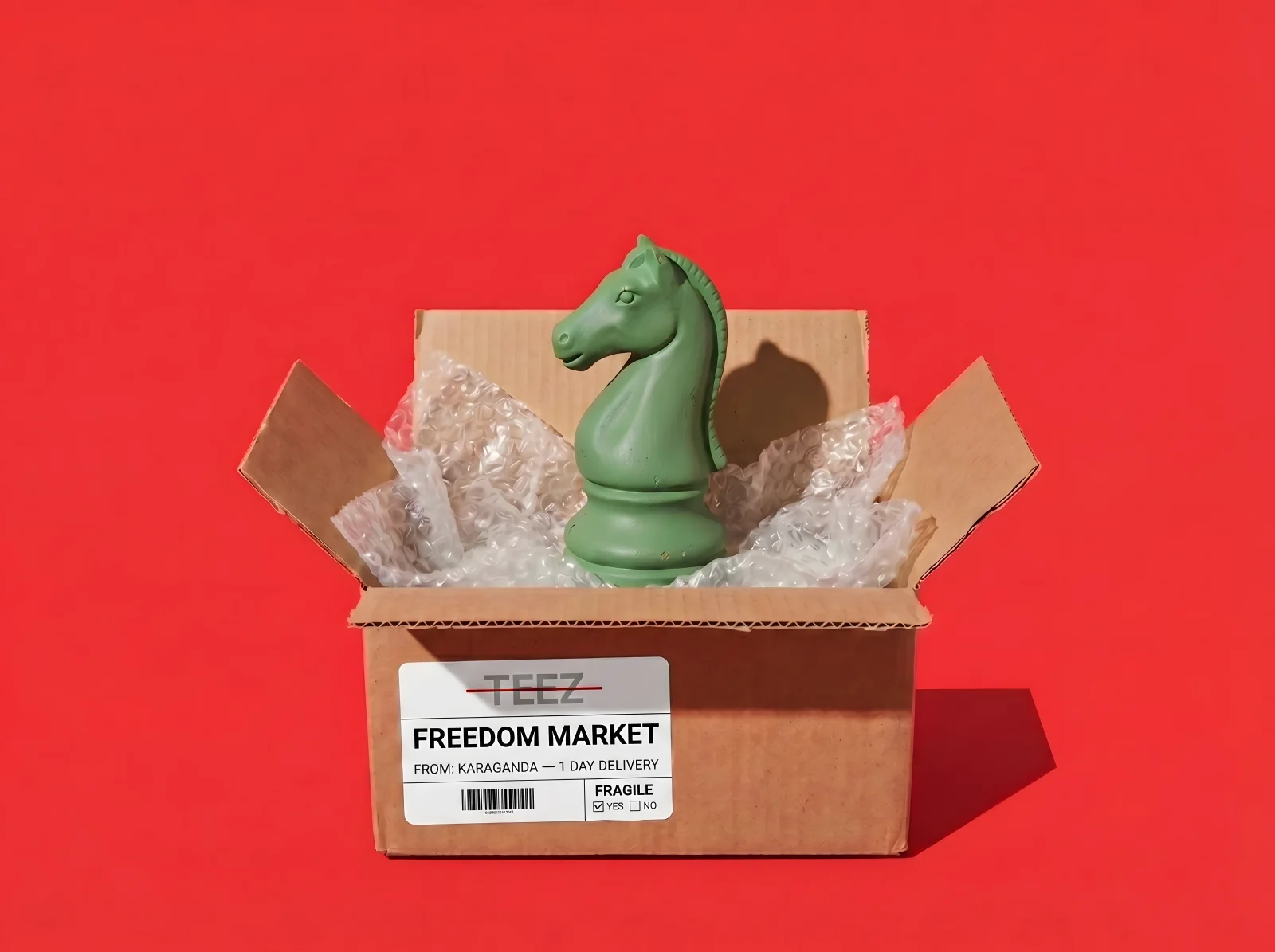
The call was followed by a letter, polite and templated: “My name is A., I represent the Freedom Market marketplace (formerly Teez).” No website, no press release, no entry in the trademark registry. The company that doesn’t exist already has a partner manager, a mailing template and a commission rate card.
The word “formerly” sits in those brackets as calmly as it would in an obituary. As recently as February, Teez was a marketplace that had been failing to pay its sellers for a second month: sellers wrote to newsrooms that the platform was “driving people into debt pits”1 while the company promised a rescue payment week after week. Then the promises stopped, the founders left, and the platform went silent. Turns out it hadn’t died. It had changed clothes.
Further down, the letter asked the question the whole exercise was apparently built around: “What, in your view, is missing from the existing marketplaces?”
Of the full-fledged “existing” ones, frankly, Kazakhstan has one. And this entire text is an attempt to answer that question in earnest: what is missing, who has it — and why the message in Zeinullayev’s phone is the opening move of the most interesting game ever played on the Kazakh market. A game that doesn’t even have a press release yet.
A Death With Ambitions
The name Teez carries two words inside it: the Kazakh “tez” — fast — and the English “tease.” It started with the first one: a September 2024 launch, the only central-warehouse model among local players based in Karaganda, free next-day delivery on any order, plans to reach “50 countries in five years”2. By spring 2025 the platform was doing 11,000 orders a day, had signed up 28,000 sellers and operated in 32 cities; orders to the west of the country flew by plane3.
By January 2026, only the second word was left. Teez had stopped being fast — and stopped paying, too. What remained was the tease.
In its Telegram channel for sellers, the platform announced it was being acquired by “a major Kazakh fintech player” whose name was sealed by an NDA, and that “the current payment delays are related to the transition period.” The company gave itself “a week and a half to two weeks” to meet its obligations4. “The marketplace is not going bankrupt, not shutting down,” Teez reassured everyone5. Technically, that wasn’t a lie, since bankruptcy is a courtroom procedure in which a debtor meets its creditors. Teez chose a lighter genre — a costume change.
From there, the timeline reads like a repayment schedule that was never once met. February: a term sheet is signed, due diligence assigned to a Big Four firm, transition period through April 16. The same week — a promise of a payment “within two weeks” that would “fully settle debts to sellers”1. Those same days, a seller writes to the newsroom of Exclusive.kz: no payouts “for the second month running,” management “feeding us promises every week”1.
In March, venture investor Yerlan Issekeshev — elder brother of Astana’s former mayor — quietly exits the ownership chain7. In April, co-founders Linar Khusnullin and Nikita Yeremin leave operational management. On his way out, Khusnullin says he is handing the company “into good hands” — “a very strong, major company building the largest ecosystem in the country”8.
For Khusnullin, this is the third marketplace brought to a sale: KazanExpress went to Russia’s Magnit in 2023, and he was a managing partner at Uzbekistan’s Uzum8. A decade has polished the formula: build fast, sell on time. KazanExpress sellers, for what it’s worth, also complained about payout delays on the eve of the Magnit deal9. Coincidence or signature — a question I don’t have the documents to answer. The sellers have the chat logs.
The buyer’s name was, all along, a secret the entire market knew and nobody would confirm. Back in February, Turlov told Bloomberg: “We may soon announce the acquisition of a local marketplace”10. In April, asked point-blank about Teez, he said: “I’m not sure we’re ready to name it”11. On June 1, Freedom Holding announced the migration of its entire ecosystem to a single Freedom brand12. And in July, a partner manager was already mailing Kaspi sellers a rate card on behalf of “Freedom Market (formerly Teez).”
There is still no press release closing the deal. But the deal already has a sales department.
Public promises
What actually happened
Jun 2024
“50 countries in 5 years”
promiseJun 2024
“50 countries in 5 years”
promiseSep 2024
Launch: next-day delivery, Karaganda warehouse
factSep 2024
Launch: next-day delivery, Karaganda warehouse
factSpring 2025
Peak: 11K orders/day, 28K sellers, 32 cities
factSpring 2025
Peak: 11K orders/day, 28K sellers, 32 cities
factJan 19–21, 2026
“A major fintech is buying us” (name under NDA); “delays = transition period, 1.5–2 weeks”
promiseJan 19–21, 2026
“A major fintech is buying us” (name under NDA); “delays = transition period, 1.5–2 weeks”
promiseFeb 12, 2026
Term sheet signed, Big Four due diligence
factFeb 12, 2026
Term sheet signed, Big Four due diligence
factFeb 19, 2026
“Payment within two weeks, debts settled”
promiseFeb 19, 2026
“Payment within two weeks, debts settled”
promiseFeb 19, 2026
A seller writes to Exclusive.kz: no payouts “for the second month running”
factFeb 19, 2026
A seller writes to Exclusive.kz: no payouts “for the second month running”
factMar 12, 2026
Venture investor Yerlan Issekeshev exits the ownership chain
factMar 12, 2026
Venture investor Yerlan Issekeshev exits the ownership chain
factApr 20, 2026
Turlov on the marketplace, at the Kursiv forum: “Whether it will be a partnership or fully our own platform - we are still deciding”
promiseApr 20, 2026
Turlov on the marketplace, at the Kursiv forum: “Whether it will be a partnership or fully our own platform - we are still deciding”
promiseApr 24, 2026
Co-founders Khusnullin and Yeremin leave management
factApr 24, 2026
Co-founders Khusnullin and Yeremin leave management
factMay 9, 2026
fmarket.kz registered, owner hidden
factMay 9, 2026
fmarket.kz registered, owner hidden
factMay 13, 2026
SSL certificate issued on fmarket.kz - including the mail subdomain
factMay 13, 2026
SSL certificate issued on fmarket.kz - including the mail subdomain
factJun 1, 2026
Freedom announces its single-brand migration
factJun 1, 2026
Freedom announces its single-brand migration
factJul 5, 2026
Call and letter to Kaspi sellers from “Freedom Market (formerly Teez)”
factJul 5, 2026
Call and letter to Kaspi sellers from “Freedom Market (formerly Teez)”
factThere is still no press release on the deal. The sales department is already working.
June 2024 — July 2026. In green (Freedom's colour) — the events nobody announced: the May 9 registration of fmarket.kz and the May 13 SSL certificate. The domain's ownership by the holding has not been established (source 42).
Source: Forbes Kazakhstan · Exclusive.kz · Orda.kz · Kapital.kz · KazNIC WHOIS · Certificate Transparency·Timeline: Brock UI
The Bank Theorem
Why Teez died is not a rhetorical question. The service wasn’t the problem; the next-day delivery was real. It died of the thing everything in this business dies of — not having a bank.
Look at the survivors. At Kaspi, installment purchases are its biggest lending product — 41% of everything the fintech platform originates — and fintech brings in ₸1.54 of the company’s ₸4.05 trillion in revenue13. At MercadoLibre — a Latin American Kaspi the size of a continent — the Mercado Pago fintech arm generates 41% of group revenue: $8.6 billion of $21 billion14. Russia’s Ozon only turned EBITDA-positive once its fintech began earning more than the storefront was losing: in 2024, the financial division delivered over 80% of group EBITDA15. Wildberries started its own bank. Etsy and Zalando live without a banking license — but those are niche players in markets where every other external provider sells installment plans. In Kazakhstan, where the installment plan is a second currency, there is no independent provider of the Klarna kind: installments are issued by the banks themselves — and none of them will hand its installment product to a rival marketplace’s checkout. Here, asking a marketplace “where is your bank” is like asking an organism “where is your heart.”
Kaspi is the rarest of cases, where the theorem ran in reverse: the marketplace didn’t grow itself a bank — a bank grew itself a marketplace all the way to market leadership. And it holds that marketplace not with assortment but with frequency: 77 transactions per active user per month13 — utility bills, transfers, QR payments at the shawarma stand.
Teez built everything except that. The warehouse, the planes, pickup points with fitting rooms — and not one tenge of installment lending: fintech sat in the plans as “the next stage”3. The next stage never came. Speed without installments is cost without leverage: you’re delivering goods, free of charge, to people who can’t afford to buy them.
The Doppelgänger
The most painful part of the Teez story is that its doppelgänger lived next door — the double from German Romantic novellas, the shadow that walks with your gait but has better luck. The double did everything the same — just in the right order.
Uzum in Uzbekistan was launched by essentially the same team: Khusnullin was a managing partner8. The same bet on next-day delivery, the same central warehouse. One difference: Uzum switched on Nasiya — its own buy-now-pay-later service — from day one. As a result, half of the marketplace’s turnover now flows through its own fintech, GMV grew 2.4x in 2024 to $345 million, and installment and microloan volume grew 2.7x16. In August 2025, Uzum raised a round from Tencent at a $1.5 billion valuation and became Uzbekistan’s first unicorn17.
One playbook, two outcomes. Uzum is a unicorn. Teez is a distressed asset with debts. The entire difference is one product, switched on a year earlier.
Uzum
Uzbekistan
Teez
Kazakhstan
Installments
Nasiya - from day one
“Next stage” - never came
GMV 2024
$345M, 2.4× YoY
never disclosed
Fintech share of turnover
~50%
0%
Outcome
Tencent round, $1.5B valuation - the country’s first unicorn (Aug 2025)
Sold with debts to sellers (2026)
The entire difference is one product, switched on a year earlier.
A mirror structure: the same team, the same warehouse-and-delivery model — and one difference, switched on from day one.
Source: Uzum press release · TechCrunch · Forbes Kazakhstan·Table: Brock UI
A Graveyard of Brands
Now, about what happens to the Teez name. Spoiler: what happens to all of them.
The history of marketplace acquisitions is a graveyard of storefront signs. Walmart bought Jet.com for $3.3 billion and shut it down four years later18. Amazon bought the Middle East’s Souq for $580 million and renamed it within two19. KazanExpress survived under its own name for about five months after the Magnit deal20. A strategic buyer pays for the warehouses, the software and the people, and brings its own sign.
Freedom didn’t even leave room for intrigue: on June 1 the holding announced its single-brand migration12, and the letter to Zeinullayev is the first field evidence that the rebranding has reached Karaganda. “Freedom Market (formerly Teez)” reads less like a name than an epitaph.
A Cautionary Tale
This is where one is supposed to write that now, with Turlov’s bank behind it, the marketplace is bound to succeed. One is not. A bank standing behind a marketplace is necessary but not sufficient — and that has been proven experimentally, with very large sums.
The experiment was called SberMegaMarket. Sber had everything Teez lacked: a bottomless balance sheet, half of Russia on its payroll cards, its own delivery network. It lacked one thing — a reason for people to open the marketplace app every day: the bank and the storefront lived in different apps, linked by SberSpasibo bonus points, a shared Sber ID and a SberPay button — but the purchase and the money never met on one screen. Sber bought growth with cashback, multiplying sales fivefold over 2023 — and then got tired of paying, cutting first the subsidies, then its own logistics. The result in 2025: minus 93%, from ₽342.6 billion to ₽24.5 billion, a slide from 4th to 38th place among Russian online retailers21. Sber’s loss from non-core activities in 2024 — the last year MegaMarket ran at full steam — was ₽284 billion; how much of that fell on the marketplace, the bank never disclosed22.
Halyk — Kazakhstan’s largest bank — runs Halyk Market, with “0-0-24” installment plans and a claimed 11 million users. It ranks among the country’s top-5 marketplaces23, and that is the extent of what can be said about it: the platform doesn’t disclose GMV, sellers don’t mention it in conversation, and it has never made a move on the leader.
The difference between Kaspi and these two isn’t money or data: Sber knows more about Russians than anyone alive. The difference is the loop. At Kaspi, the bank and the storefront are one organism — the installment decision happens in the same click as the purchase, and 77 monthly transactions keep the user in the app daily. At Sber, the bank and the marketplace were neighboring buildings with separate entrances. A marketplace can be bought with money. Frequency can’t.
Ozon · fintech revenue, ₽B
+120%in 2025
| Label | Value |
|---|---|
| 2024 | ₽88.8B |
| 2025 | ₽195.2B |
fintech delivers >80% of group EBITDA (2024)
SberMegaMarket · sales, ₽B
−93%in 2025
| Label | Value |
|---|---|
| 2023 | ₽312B |
| 2024 | ₽342.6B |
| 2025 | ₽24.5B |
the toll: from 4th to 38th place among online retailers
Sber had more money and more data. Ozon had the bank inside the storefront.
Ozon's fintech rises, MegaMarket falls. Panels on their own scales: fintech revenue on the left, storefront sales on the right.
Source: Ozon IR · Data Insight·Chart: Brock UI
The Price List of a Company That Doesn’t Exist
Back to the letter. It contains a table no media outlet has — Freedom Market’s commissions for its first partners.
A commission is the platform’s cut of every sale, and it depends on how the buyer paid. If the customer pays by card or takes a bank loan, the store gives Freedom Market 5% of the receipt. If they take an interest-free installment plan, the commission climbs with its length: 6% for three months, 8% for six, 11% for nine, 13% for twelve, 14% for twenty-four.
| Label | Value |
|---|---|
| Card | 5% |
| Loan | 5% |
| 3 mo | 6% |
| 6 mo | 8% |
| 9 mo | 11% |
| 12 mo | 13% |
| 24 mo | 14% |
+9 p.p. - the seller’s price of two years of installments.
Funding two years at deposit rates costs the bank 1.7-2× more than these 9 points.
Exclusive data. A commission is the platform's cut of each sale, paid by the seller; it depends on how the buyer paid.
Source: Freedom Market terms for first partners, July 2026; correspondence on file with the author·Chart: Brock UI
The ladder is more interesting than it looks. A loan costs the seller the same as a card payment, because the interest there is paid by the buyer. Installments get pricier with length because someone has to finance the buyer’s “zero percent” — and that someone is the seller, through the elevated commission. Let’s do the math. The seller’s surcharge for a 24-month plan over a card payment is 9 percentage points of commission — that is, 9% of the receipt, paid once. But the bank has to source that money for two years: even funded at retail deposit rates, financing a two-year installment plan costs 1.7-2 times those 9 points24. Either Freedom is deliberately subsidizing long installments to poach sellers, or it is counting on money cheaper than the market’s. Below, I’ll explain why I believe the second.
Beyond the numbers, the letter makes promises — and every one lands on a specific pain of the Kaspi seller. “Not a tender platform: every store gets its own storefront, like on Wildberries and Ozon” — against the single-listing model, where up to five dozen sellers sit on one iPhone listing and cut into each other’s margins25. Promo codes and “measurable ad spend” — against advertising blind. Open categories — against category turnstiles. The commission rate is almost beside the point — what Freedom is selling is everything Kaspi wouldn’t allow.
And one detail the letter omits — payout terms. For a platform whose previous incarnation spent two months not paying people, a strange thing to forget. Zeinullayev asked about it himself and was told that at launch, money arrives the day after the item is handed to the customer26. At Kaspi — same day. One day’s difference is a small price; the only question is whether the market remembers what the word “tomorrow” once looked like at this particular warehouse.
The calls with first partners surface things the letter doesn’t mention. Both operating modes will be available: selling from your own warehouse (FBS) and from the Karaganda fulfillment center — which industry convention will presumably force us to call FBF, Fulfillment by Freedom26. Kaspi has no fulfillment of its own for third-party sellers as of publication — and for sellers from Russia, Uzbekistan and China this is an open door: load your goods into the warehouse and sell, without an office or a courier in the country. Commissions, according to the platform, will be identical for everyone — including the holding’s own services such as Arbuz26: a level-playing-field pledge that is easy to make before launch and hard to keep after.
The Arsenal
Consider what actually stands behind the letter. Freedom Holding closed its fiscal year with record revenue of $2.19 billion and net income doubled to $153 million — doubled, in fairness, off a dismal prior year: two years ago the holding earned $379 million. Assets grew by a third to $13.2 billion. Monthly super-app audience grew two-and-a-half-fold over the year to almost 2.6 million; bank customers reached 5 million, brokerage accounts 858 thousand27. The “five million already use Freedom” line from the partner manager’s script isn’t marketing rounding but a number from the filings. One clarification: the five million are bank clients; 2.6 million are active in the super-app.
Plus the Teez inheritance: the only central-warehouse logistics model among local players, capable of next-day delivery — the very line item Sber, tired of paying, cut at MegaMarket.
Plus something Teez never had for a single day — an instrument for bringing people back. Sellers will come to a new storefront on their own: for a merchant, a second platform is a line in a spreadsheet, not a relocation, and Russian research shows sellers on two platforms earn multiples of what they earn on one28. The scarce resource in this game is the buyer. Teez bought buyers with cashback, ads and influencers exactly as long as the money lasted: the campaigns were the first thing to stop, and their “resumption” featured as a separate line item in the new owners’ February promises1. Between orders, a person had no reason to open the Teez app at all. Freedom has that reason ready-made — the super-app’s cashback, already used by millions — on utilities, flights, purchases across the holding’s services. And it accrues not in money or points but in an exchange-traded note tied to the holding’s own stock, straight into the client’s brokerage account. Wire it up so that this cashback is spent and earned through the marketplace, and the storefront acquires what took Kaspi a decade to build: reasons to open the app with no intention of buying anything.
Plus the bank — and here the credit conveyor deserves a closer look, because in Kazakhstan the conveyor, not the storefront, decides the outcome. Plenty of players “have” installment plans. They approve them very differently, and nobody publishes the numbers: checkout approval rates by bank are an officially blind spot — publicly, neither the regulator nor the credit bureaus track them29. Only the market-wide background is known, and it is harsh: on average, 26–31% of loan applications get approved30. Up to three out of four applications are turned down — in a country where 8.1 million people carry active unsecured consumer loans31. Kazakhstan is a country that lives on credit and gets turned down for it. Kaspi’s own filings name instant automated credit decisioning as the core of the model32 — and it pays for its risk appetite in delinquency: Kaspi Bank’s non-performing loan ratio is 5.2% against the sector-wide average of 3.4%, a mix that includes mortgages and corporate loans33. Approval is not the scoring engine’s mercy; it is a business decision with a price tag, and Kaspi pays it deliberately. Tellingly, ForteBank — whose installment approvals the sellers we spoke to privately call hard to pass — simply bought Home Credit Bank in 2025, a specialist in point-of-sale lending34. Banks don’t buy someone else’s scoring when their own works.
The real exam for Freedom is whether the banking data of five million clients — without Kaspi’s daily payment frequency — is enough for a comparable share of “yes” at the moment of purchase. The storefront and the warehouse have been bought. The conveyor will have to be built.
Plus the seller side, where Freedom has a move nobody in Kazakhstan has made. In Russia, banks spent 2026 openly buying up “eyes”: Tochka, a bank for entrepreneurs, acquired the analytics service MPSTATS for roughly ₽2 billion; Alfa-Bank answered with MarketGuru35. Tochka’s CEO articulated the logic: data, money and management decisions should live together. A bank that sees a seller’s sales can lend to them cheaper than anyone and keep their account longer than anyone. Freedom can assemble that loop from scratch and in full: a merchant account, credit against turnover — and a three-layer data infrastructure. Internal cabinet analytics, so a seller sees their unit economics down to the tenge: margin per item, cost of advertising, cost of a return. External market analytics — which niches are growing, where it’s uncrowded, where to enter. And an open API, so that an ecosystem of third-party services grows around the platform the way it did around Wildberries — analytics, advertising, SEO tools: every such service markets the marketplace to its own users, free of charge. A platform whose previous name became a synonym for delays can make transparency and the speed of money its banner. Same mechanics, opposite sign.
And the third weapon on this flank is the cheapest one: talking. The Kaspi seller’s pain isn’t only commissions. A seller cabinet can hold tens of millions of tenge in turnover, and a block can arrive over a single customer review — the seller community passes these stories around like campfire horror tales, and the appeal procedures in them look like a formality. Freedom opened with the opposite gesture: the manager isn’t selling — she is collecting feedback, and after the letter an entire department got on calls with Zeinullayev, asking about strategy, pains and missing tools26. A platform that asks “what’s missing” before launch already differs from Kaspi, which in a decade of dominance never — sellers say — built them even basic internal analytics. “Many sellers can’t properly compute their own unit economics — the infrastructure just isn’t there, though it would be simple to build. Apparently someone benefits from people not knowing how to count their money,” is how Zeinullayev puts it.
Dresses First
If someone asked me which square to open this game on, I would answer: not electronics, where Kaspi’s heavy pieces stand — the wardrobe.
Clothing and footwear make up about 7% of Kaspi’s category turnover — against a quarter of the market on Wildberries36. The category where the Kazakh shopper already votes with their wallet (WB.kz in Kazakhstan grows first and foremost on fashion) is nearly absent from the country’s main marketplace. The money in Kazakhstan’s wardrobe is currently leaving for a Russian platform — not because it is better, but because a local alternative with a warehouse and fitting rooms simply does not exist. Kaspi is an electronics store the size of a country: electronics take 27% of its turnover, clothing sits in the tail of the table.
₽5.7T of ₽23.2T in orders · Jul 2025 - Jun 2026
3.6× - fashion’s underrepresentation on Kaspi (structures compared across different windows: an order of magnitude, not a precise ratio)
₸11.6B of ₸168.8B · April 2026, top-15 categories · electronics on Kaspi - 27.4%
WB - full year, orders; Kaspi - monthly snapshot of top-15 categories; a comparison of structures, not absolutes.
Alt: fashion's share of turnover — 24.7% on Wildberries vs. 6.8% on Kaspi, a 3.6x gap.
Source: MPSTATS · Redstat · author’s calculations·Chart: Brock UI
And this is not a category-management oversight. It’s architecture. A year of Wildberries data shows that fashion is the only major category that physically cannot exist without the platform’s warehouse. 85% of its turnover runs through fulfillment, and the share of dresses sold from WB warehouses never dropped below 92% in any month of the year36. You cannot sell a dress without a warehouse, a fitting room and an easy return. Kaspi has none of the three — and this gap doesn’t close by hiring a category team. It closes with a warehouse. Which Freedom already owns — along with the fitting rooms in the pickup points inherited from Teez.
| X | WB market-wide fulfillment share | April - source anomaly |
|---|---|---|
| Jul | 24.4% | — |
| Aug | 28.5% | — |
| Sep | 35.3% | — |
| Oct | 47.6% | — |
| Nov | 48.1% | — |
| Dec | 50.3% | — |
| Jan | 49.6% | — |
| Feb | 47.6% | — |
| Mar | 46.5% | — |
| Apr | — | 34.0% |
| May | 44.4% | — |
| Jun | 34.2% | — |
Fashion, meanwhile, lives in the warehouse year-round: clothing’s fulfillment share never drops below 76%.
In % of WB turnover, monthly. Peak season cannot be survived without a warehouse: the market-wide fulfillment share doubles into December.
Source: MPSTATS, twelve monthly windows · author’s calculations·Chart: Brock UI
Now reread the partner manager’s letter with this lens. “Every seller gets their own store” is a fashion format: a dress, unlike an iPhone, is sold by a store’s face and content, not by the lowest price in a shared listing. UGC and promo codes are fashion instruments. Fitting rooms are fashion infrastructure. Freedom Market — perhaps without having articulated it — has assembled a toolkit for exactly one category: the only one where Kaspi cannot answer without rebuilding its entire model. In electronics, Kaspi parries within a week by adjusting an installment rate: that is its fortress. In clothing, it would have to build warehouses and reinvent its own product listing. Military theory has called this a flank attack since Cannae, where Hannibal yielded in the center and closed his wings: a blow the opponent cannot reinforce against without restructuring the whole army. Wildberries, for the record, started as a clothing store — and took everything else from that beachhead.
The beachhead itself is a model already proven next door: Wildberries began precisely with clothing, built the CIS’s largest marketplace on it, and still holds a quarter of its turnover in the category — every number in this chapter is computed from its data. How to accelerate the category, though, is a lesson from Shein: the Chinese fast-fashion giant took off without a single physical store — on micro-batches, instant demand response, and customer-generated content instead of advertising. For Freedom the two examples add up to a division of labor: Wildberries supplies the proof that fashion builds marketplaces; Shein supplies the acceleration playbook — and both halves assemble from parts Freedom already owns: a warehouse with fitting rooms, the UGC tools from the letter, the open FBF door for sellers from China — the very ones who carry fast fashion.
The dress here is an image, not the whole plan. This is about fashion as a category: clothing, footwear, lingerie, accessories — a quarter of the neighboring market, surrendered in Kazakhstan without a fight. The second target of the first wave is visible in the same table: long-shelf-life groceries. Back in November 2024, the “Food” category on Kaspi did about ₸0.3 billion a month; now it does ₸6.6–7.8 billion — growth of twentyfold and change36. Yet entry to the category is open to barely more than two hundred sellers nationwide, and in April exactly three companies were selling vegetables — with revenue averaging just under a quarter of a billion tenge per company36. In other words, demand has been proven with Kaspi’s own money, while supply is held back by a turnstile — a rare case where you can judge the length of the queue by how narrowly the door is cracked open. Freedom, meanwhile, already owns Arbuz with its perishables logistics — and the promise of “open categories” in that very letter.
One honest caveat: dresses don’t monetize through installment plans — the receipt is too small for the credit conveyor. What fashion buys is frequency and habit, not margin. The margin arrives later — together with the television.
The Move That Isn’t in the Letter
Now the main thing — a move that isn’t in the letter. It may well have been mapped out on the holding’s internal slides long ago; what’s visible from the outside is something else — that nobody on the market has made it. Freedom owns one asset that neither Kaspi, nor Halyk, nor anyone else on this market has. A broker.
Look at the world map. Yield on sellers’ balances is already paid by Western platforms — Shopify has a dedicated product for it, Shopify Balance. There is also a principled counterexample — Amazon: its merchant wallet, Amazon Seller Wallet, pays nothing on balances, zero percent — the world’s largest marketplace consciously declines to share the yield on its sellers’ own money. Cashback in real stock through one’s own broker is already paid by eToro — 4% on its debit card since June 202537. Wallet balances are auto-invested by MercadoLibre: its Mercado Fondo fund has grown to $18.8 billion under management38, and its Chinese progenitor Yu’e Bao held $267 billion at its peak — until the regulator cut the limits. Kaspi has assembled the marketplace and merchant deposits — the storefront and the money, but not the loop. Deposits Kaspi does have — retail ones and a Business Deposit for merchants; what it lacks is yield by default on every working tenge, and the floor above the deposit: securities. But the triple link — a marketplace, yield on sellers’ money, and rewards in securities through one’s own broker — has, as far as public disclosures allow one to judge, never been assembled by anyone in the world39. It requires a triple stack: a working marketplace plus a banking license and a broker-dealer license at once. Freedom — if the Teez deal has closed — holds all three in one vault — and it is the only player whose brokerage is the core of the business, not an appendage to a bank.
In practice, it works like this. A seller’s revenue lands, by default, on an account that accrues interest daily. This is not a brokerage account with stocks: a seller needs safety and instant access, so the mechanics differ — the rate on the balance is tied to short, safe money-market instruments, and the yield drips in daily, visible in the app. That is exactly how Yu’e Bao works inside Alipay and Mercado Fondo inside MercadoLibre; at Kazakh interest rates, that “+X tenge today” line becomes visible to the naked eye. Money can be withdrawn instantly and free — but every day it sits, it earns. “Unprofitable to withdraw” means precisely this: nobody forbids the seller anything; the account is simply built so that keeping money inside is the rational choice, not a constraint. There is a fork here, and it should be named honestly: money that actually leaves for a fund is money the bank cannot lend — that is how Mercado Fondo works; in the installment model the bank pays the daily interest itself, slightly below market, and the balances remain its funding — the cheapness is the spread between the seller’s rate and the market price of money. Those voluntarily left balances are what funds the next buyer’s installment plan. Which is, incidentally, where the economics of that suspiciously generous commission ladder may come from. Securities enter the construction on the other side of the counter — with the buyer: their cashback doesn’t expire as points but settles into a portfolio as fractional shares via the holding’s broker. Behavioral studies have shown that recipients of a brand’s stock increased their spending by double-digit percentages40. And the buyer of a kettle quietly becomes a brokerage client at zero acquisition cost — for a holding whose highest-margin business is precisely brokerage: per the segment reporting, the brokerage segment’s pre-tax margin is about 55%, the banking segment’s about 15%27.
Kaspi’s imperial metric is frequency: 77 touches a month. The only metric that can answer it is the lifespan of a tenge inside the system. Kaspi owns its users’ time. Freedom could own their capital.
The Journey of One Tenge
Two paths for a seller’s revenue: a settlement account at Kaspi and a daily-yield account in the proposed Freedom model.
Kaspi: the tenge's path ends
- 1.Salethe item is sold; the money sits with the platform
- 2.Same-day payoutmoney lands on the settlement account
- 3.Account: 0% yieldan account, not a deposit
- 4.The coin goes darkthe tenge sits earning nothing
Freedom (a model): the path closes into a loop
- 1.Salethe item is sold; the money sits with the platform
- 2.Payoutonto a daily-yield account
- 3.Yield every daymoney-market instruments
- 4.Funds the next installmentthe tenge stays in the loop
The “Freedom” game is the author's model built on public precedents (Mercado Fondo, Shopify Balance) - not an announced Freedom product. The Kaspi game is simplified to default behaviour: Kaspi does offer deposits - including a Business Deposit for merchants - but they require a separate action. The final step illustrates idle money at zero yield, not a purchasing-power calculation.
Prototype and analysis: Almas Kasymzhanov · precedents: Mercado Fondo, Shopify Balance
In fairness: the first products built on this mechanic are dead. Bumped burned through $32 million of investment and was sold for $631 thousand — the startup had to build both the broker and the audience from scratch41. Grab shut down its auto-invest in overbanked Singapore, where a 1.8% yield warmed nobody. Both products died of lacking what Freedom already has: a broker at the core of the business, and double-digit rates at which yield on a balance is visible to the naked eye. A rare case where an idea that buried startups can only be lifted by an incumbent — a sitting heavyweight who needs to build neither the license nor the audience.
Three Unanswered Questions
First — the debts. There is still no official confirmation that Teez’s obligations have been settled; the total size of the debt was never disclosed. The field signal is cautiously positive: the sellers Zeinullayev talks to got their money — “there were delays, but no real problems”26. On former employees’ wages there is not even that much of a field signal. If the books are indeed closed, Freedom bought, along with the warehouse, the chance to quietly turn the worst page of its history. It remains to say so out loud, because here silence works against the buyer.
Second — legal status. The deal is confirmed neither by a press release nor by a Nasdaq issuer’s disclosure; a Freedom Market trademark is nowhere to be found in the open registries. A domain, however, is. fmarket.kz — the natural name in the holding’s nomenclature, where Freedom Finance lives at ffin.kz and Freedom Telecom at ftel.kz — was registered on May 9, 2026: two weeks after the Teez founders left management and three weeks before the Freedom brand unification. Registered through the same registrar that services ffin.kz and ftel.kz, with the same hidden owner as the flagship ffin.kz42. And four days later, an SSL certificate was issued on the domain — covering, among others, the mail subdomain mail.fmarket.kz42. Domains bought for resale don’t set up email. Whoever stands behind the purchase, the week of May 9–13 speaks for itself: someone was already building infrastructure under the name of a company that doesn’t exist. The sales department is moving faster than the lawyers — normal for a launch, corrosive for sellers’ trust. Every promise from the partner manager so far exists in the same genre as Teez’s promises in January: verbal, and pre-launch. A separate storyline is the SEC: in March, the company and Turlov personally received a Wells Notice — after a five-year investigation, the SEC staff had reached a preliminary determination to recommend a civil enforcement action. In June Turlov framed it as good news — the investigative phase is over — but the company is contesting the SEC’s findings, and the question of a lawsuit remains open43. The final terms of that denouement are still to be read by investors.
Third — timing, and it cuts both ways. Freedom is rolling out an installment-driven marketplace at the precise moment the regulator is cooling consumer lending: unsecured loan issuance is falling in real terms, debt-burden limits are in force, further tightening is under discussion31. The machine that must tell the buyer “yes” will be accelerating into a headwind. But the wind has a favorable side — two of them. First: the less often banks approve installments, the more often the buyer pays in full — and a full-price purchase with cashback at a 5% commission is exactly the cell of the rate card where Freedom Market beats everyone. “Approvals are down — many will just pay upfront. And upfront is a cashback story,” Zeinullayev reasons. The second side is political: the country’s leadership has spent years publicly demanding that banks pivot from consumer lending to lending to business44. A working-capital loan to a seller is a loan to a small business: a marketplace that learns to finance the entrepreneur rather than the shopper will find itself not against the state agenda but inside it — a rare position for a fintech in a tightening cycle. And the better this whole machine runs, the more attentively the regulator will study it: the fate of Yu’e Bao, throttled by limits at its peak, is a mandatory chapter in any textbook about money that stays in the loop too well.
In Lieu of an Epilogue
I asked Zeinullayev whether he himself would join Freedom Market. He answered without a pause: yes. “Companies like Kaspi need competitors. Where there’s competition, there’s growth. And you’re not dependent on a single sales channel.” Since the letter, an entire team from the platform has been on calls with him — discussing strategy, trading questions. That, most likely, is how dozens of large Kaspi sellers are reasoning right now: an empty storefront is cheap visibility and commissions from 5%, and even the warehouse of a company that owed people money four months ago stops being frightening — if the people it owed have been paid.
And while the sellers do their math, look at the whole board. Kaspi last year stepped onto the Turkish board, buying 65% of Hepsiburada — the country’s No. 2 marketplace45. Freedom this year answered on the same board: in June the Turkish regulator approved the holding’s purchase of a bank46 — while quietly entering Kaspi’s home market through the Karaganda warehouse. Two grandmasters have simultaneously started games on each other’s boards. Only this is not a simultaneous exhibition, where a master walks past novices’ tables. These are two counter-games, and both boards seat champions.
The partner manager’s letter asked what was missing from the existing marketplaces. My answer: for ten years, the market has been missing a second player. Looks like exactly that order is being assembled right now — at that same warehouse in Karaganda. And from there, as we remember, they deliver in one day.
From here, the game can be recorded in notation. Next-day delivery — a move. A commission from 5% — a move. Storefronts instead of a shared listing, open categories, next-day payouts — move, move, move. Kaspi has an answer to each: the champion has the conveyor, the frequency and a ten-year head start. But one piece on the board belongs to Freedom alone, and it cannot be bought with money — the broker. Play it the way described above, and it is no longer an exchange of pawns. It is check. Not mate: mate is far away, and nobody in the country defends better than the champion. But what is it like — to play against yourself for ten years and suddenly hear a piece being moved across the table?
The clock is already running.
Sources
Russian-language sources are marked; links lead to the originals cited.
- Teez to settle debts to sellers after the fintech deal — Exclusive.kz, 19.02.2026 (in Russian).
- Teez: the first Kazakh marketplace with free next-day delivery — Forbes Kazakhstan, June 2024 (in Russian).
- Teez six months on — Zakon.kz, 18.04.2025 (in Russian).
- A Kazakh marketplace is being sold to a major fintech — Forbes Kazakhstan, 21.01.2026 (in Russian).
- “We are not going bankrupt” — Orda.kz, 20.01.2026 (in Russian).
- Teez undergoing pre-sale due diligence — Kapital.kz, 2026 (in Russian).
- Teez ownership changes before the deal — Forbes Kazakhstan, 31.03.2026 (in Russian).
- Two Teez co-founders exit operational management — Forbes Kazakhstan, 24.04.2026 (in Russian).
- KazanExpress sellers’ complaints about payout delays before the Magnit deal — Oborot.ru; Realnoe Vremya, October 2023 (in Russian).
- Turlov’s Bloomberg interview via The-tech.kz, 03.02.2026 (in Russian).
- Freedom Holding takes the Kazakh super-app model to Turkey — National Business, 17.04.2026 (in Russian).
- Freedom announces brand transformation — LS, 01.06.2026 (in Russian).
- Kaspi.kz 4Q & FY 2025 Financial Results — Kaspi.kz IR, 02.03.2026.
- MercadoLibre Q4 2024 results — GlobeNewswire, 20.02.2025.
- Ozon: 2024 results, fintech’s share of group EBITDA — Ozon IR; 2025 results, fintech revenue ₽88.8B → ₽195.2B (+120%) — Ozon IR (in Russian).
- Uzum 2024 results — Uzum press release, 24.02.2025 (in Russian).
- Uzbekistan’s first unicorn, Uzum, leaps to a $1.5B valuation — TechCrunch, 05.08.2025.
- Walmart grounds Jet.com — Axios, 20.05.2020.
- Amazon rebrands Souq — Retail Dive, May 2019.
- KazanExpress to be fully “reborn” by end of 2024 — Logirus, April 2024 (in Russian).
- MegaMarket sales collapse 93% in 2025 (Data Insight) — Investing.com; RB.ru. Turnover grew 5x in 2023 — RBC / Data Insight, 29.01.2024 (in Russian).
- Sber posts ₽284 billion loss from non-core activities in 2024 — Interfax (in Russian).
- Halyk Market enters Kazakhstan’s top-5 marketplaces — Nur.kz (in Russian).
- Author’s estimate: on a 24-month annuity schedule the average outstanding balance is ≈52% of the receipt; funding at retail tenge deposit rates (term deposits ≈15-18% p.a., short ones up to 20.5%: KDIF; Tengrinews, 03.2026 (in Russian)) costs ≈16-19% of the receipt over two years, against the seller’s 9 p.p. surcharge. The estimate is nominal, uses marginal (not blended-with-CASA) funding and no discounting — in present value the multiple is ~1.5-1.8 and the conclusion holds; early repayments, the bank’s adjacent income and the upfront nature of the commission are not counted (they cheapen it), nor is credit-risk cost (it makes it dearer).
- Redstat data, April 2026: 59 sellers on the iPhone 17 Pro 256Gb listing; 35–59 sellers on each of the eight top-selling iPhone listings.
- Nurbek Zeinullayev’s correspondence and calls with the Freedom Market team, July 2026. Records and screenshots on file with the author; published with Zeinullayev’s consent.
- Freedom Holding Corp. FY2026 results — Nasdaq/FRHC, 02.06.2026.
- T-Bank eCommerce research (October 2024): average seller income on one platform — ₽53K/month; on two — ₽137K/month — T-Bank (in Russian).
- ARDFM, NBK Bank Lending Survey, FCB DataHub — bank-level approval rates are not published (in Russian).
- Loan-application approval rates: AFK reviews for 2024 and 9M2025 — Forbes.kz; Finprom on NBK data — Tengrinews (in Russian).
- Kazakhstan’s credit market: H1 2025 results — DataHub / First Credit Bureau (in Russian).
- Kaspi.kz Form 20-F — automated loan approval process.
- Kazakhstan’s banking sector in June 2025 — Halyk Finance (in Russian).
- ForteBank absorbs Home Credit Bank — The Tenge, 2025 (in Russian).
- Tochka bank acquires 100% of MPSTATS — BG.ru, February 2026 (in Russian).
- Author’s calculations: Kaspi category shares — Redstat, April 2026; Wildberries structure and fulfillment shares — MPSTATS, July 2025 — June 2026, twelve monthly windows (clothing’s FBW share by monthly windows — never below 76%, averaging 85.2%). “Revenue” in MPSTATS data means orders, not completed purchases. Datasets and methodology available on request.
- eToro launches debit card in Europe, giving users 4% back in stock — eToro, 24.06.2025.
- MercadoLibre: Mercado Fondo AUM dynamics — MELI Letters to Shareholders.
- Author’s prior-art survey of public disclosures and product announcements, June–July 2026. Methodology and source registry available on request.
- Medina, Mittal. NBER Working Paper No. 28479 (2021): brand stock ownership and consumer spending — NBER.
- Bakkt acquires Bumped Financial for $0.63M (08.02.2023, cash) — Bakkt 10-K 2023 (SEC).
- KazNIC WHOIS (05.07.2026): fmarket.kz created 09.05.2026, PS Internet Company, owner redacted; ftel.kz — same registrar, Freedom Telecom Operations; ffin.kz — owner likewise hidden. Certificate Transparency (CertSpotter): 13.05.2026 — a Let’s Encrypt certificate for fmarket.kz, www and mail; the subdomain set may reflect a hosting panel’s default configuration. A shared registrar is not by itself proof of ownership.
- Billionaire Kazakh brokerage CEO got SEC enforcement warning — Bloomberg, 02.06.2026; Kursiv, 03.06.2026.
- Public statements by the country’s leadership on pivoting banks to business lending, 2023–2026.
- Kaspi.kz completes acquisition of 65.41% of Hepsiburada (~$1.1B) — GlobeNewswire, 29.01.2025; Turkish strategy — Kaspi.kz IR.
- Turkish regulator approves Freedom Holding’s acquisition of 99.3% of Turkish Bank A.Ş. — 24.kz, 30.06.2026 (in Russian); FRHC release, 01.07.2026.
Get Kasymzhanov in your inbox / New investigations and data notes from Kazakhstan and Central Asia.
Comments 0
No comments yet. Be the first.