

Almas Kasymzhanov is an entrepreneur and analyst writing about marketplaces, technology and Central Asian economies. He also writes for Forbes Kazakhstan.
They've mined coal in Ekibastuz for a hundred years. The gesture hasn't changed in a century: bite into the seam, lift the black rock, throw it in the furnace. First they mined heat that way. Then electricity. Now, with the same gesture, they'll mine artificial intelligence.
Above the open pit stands a chimney. At 419.7 metres — 1,377 feet, taller than the Eiffel Tower, taller than anything built in Kazakhstan — it is the tallest flue on Earth. For almost forty years it scattered across the steppe the smoke of GRES-2, a coal plant burning rock from the pit next door. The chimney was the exclamation point of the last century: coal, steam, metal, smoke.
On June 15, 2026, in Astana, Prime Minister Olzhas Bektenov shook hands with NVIDIA vice president Rev Lebaredian. Beside them stood the founders of the American company Firebird. They signed agreements the government valued at ten billion dollars: the "Data Center Valley" project, a hundred thousand cutting-edge GPUs, capacity up to a gigawatt, the first data center by 2027. The minister of artificial intelligence, Zhaslan Madiyev, promised no less than $3 billion in export revenue a year and infrastructure "for decades ahead." Coal did come up at the ceremony — but as a virtue: the project was pitched as a way to "turn Ekibastuz coal into export digital revenue." What that coal will cost — not a word.
A pity. "The cloud" — that's what we've gotten used to calling data centers: the place where our files, our chats, our neural networks live. In Ekibastuz this cloud will be assembled out of another cloud — the one rising over a chimney 419.7 metres tall. The digital future here will smell of coal. And that's meant literally — it's how the power is wired.
I took the public documents, the ministries' answers, industry statistics, and independent estimates — and ran the numbers. The picture splits into two stories, though the press releases fuse them into one. First, the money mostly isn't here yet; what exists is a promise. Second, the power is mostly coal, and to feed the new digital economy the country is preparing to build new coal generation. Neither cancels the project's real value. But the value doesn't cancel the cost either. The numbers follow, and readers can draw their own conclusions.
I. The deal that isn't there yet
Start with the ten billion. A pretty figure — round, easy to remember — and almost entirely in the future tense.
On June 15, two documents were signed. The first — a framework agreement on strategic cooperation between the Ministry of Artificial Intelligence and Firebird. The second — a "binding term sheet1 " between a subsidiary of Kazakhtelecom and the same Firebird. Neither is a closed investment deal, a construction contract, or confirmed financing. A term sheet is more like an engagement, with the wedding still a long way off. Or an architect's render of a building whose foundation nobody has poured.
Ten billion is the stated "total investment volume" across several agreements at once — neither confirmed financing nor a single check written. The structure has since been clarified publicly: the first stage — about five billion, including roughly one billion from the state-controlled Kazakhtelecom; the commercial launch of the first 125-MW phase is slated for 2027. The second stage — another five billion or so, with no timeline set. Under the deal's structure, Firebird's Kazakh subsidiary supplies and finances the compute itself, while Kazakhtelecom provides power, cooling, and connectivity.
But this too is a stated plan, not confirmed capital. How much hard capital is in the ground today, no one disclosed — not the government, not the companies. One named billion from the state telecom operator, plus a promise to raise the rest, is not money invested yet: per Reuters, the Kazakh side handles construction of the "Valley," while Firebird's role is to supply equipment and attract major global players. And the thirty billion the prime minister floated in January as a long-term marker has no publicly named source of financing behind it.
Hatching — stated sums, not firmly confirmed; solid — firmly named capital.
Source: primeminister.kz · Reuters · Bloomberg · The Next Web·Charts: Brock UI
Who is Firebird? An American company out of San Francisco that only emerged from stealth2 in June 2025 — less than a year before the Kazakh signing. There's almost no public record of it: at the time of the announcement, so little was known that its website was a single page with no explanation. Its co-founder and CEO, Razmig Hovaghimian, previously built not data centers but video streaming — the service Viki, which Rakuten bought. At the signing, Firebird had exactly one announced project — a center in Armenia. It has since grown on paper from $500 million to $4 billion (a second phase, for 41,000 NVIDIA chips, was announced in February 2026 during a visit by the US vice president), and in March 2026 six Armenian financial institutions signed a syndicated loan of $300 million behind it. But even the first phase is only now coming online, as of summer 2026. So the company's résumé is short: one country, one project, still proving itself in operation.
NVIDIA, in this scheme, isn't an investor. Its role is to supply chips (the current GB300 generation and the future Vera Rubin) and to advise technically. The company puts no money into construction. There's also a separate risk that gets too little attention. Chips of this class require an individual US export license. The question is complicated by the fact that Kazakh companies have already faced US sanctions designations for re-export to Russia, and under that pressure Kazakhstan tightened its own export controls in late 2024. For a hundred thousand chips worth $10 billion, this isn't background but a question of sanctions compliance — and Washington's central one: are there guarantees they won't leak onward? Firebird has a precedent for approval — the US granted the license for the Armenian project. But Armenia isn't Kazakhstan, and at the time of signing the Kazakh license wasn't publicly confirmed.
None of this makes the project a fiction. Framework agreements are a normal first step for big builds; real gigawatts have started this way too. But between "signed for ten billion" and "invested ten billion" lies a distance measured not in press releases but in executed contracts and poured concrete. So far a framework agreement and a term sheet are signed — the concrete isn't poured yet.
II. Where the power comes from
Now to the most important part, since a gigawatt compute cluster is, first and foremost, a power plant with servers bolted on.
The "Data Center Valley" will sit on the Ekibastuz power hub. That means GRES-1 and GRES-2, two coal plants running on local Ekibastuz coal. In an answer to the outlet Kursiv, the digital ministry put it plainly: power is supplied by GRES-1 and GRES-2, with 300 MW reserved at the start, growing to a gigawatt. Pavlodar Region itself is the country's energy heart: it accounts for about 42% of all of Kazakhstan's electricity generation, and almost all of it is coal.
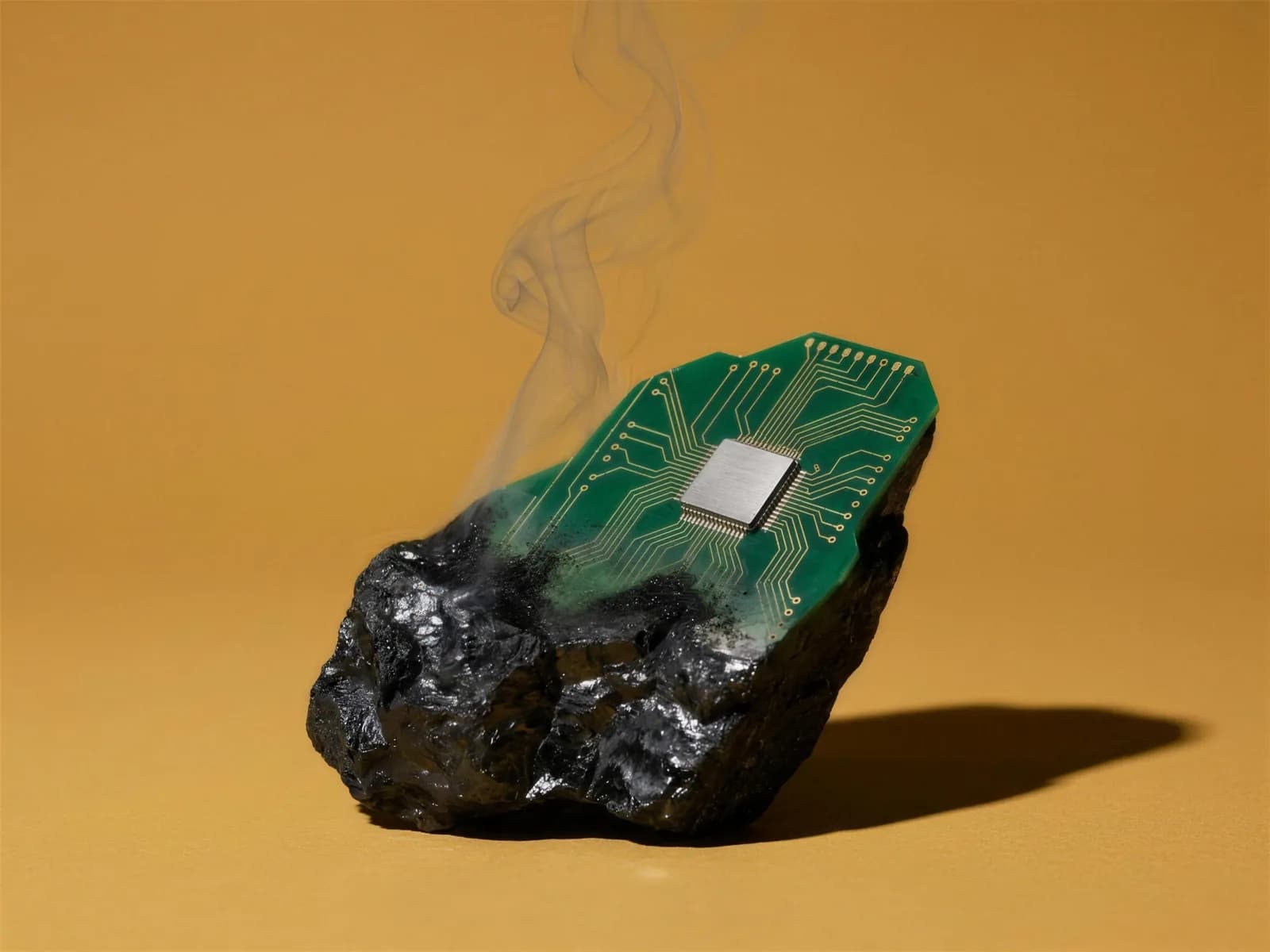
In nature there are two stones this story rests on. Silicon and coal. The first becomes chips, so the machine can learn to think. The second is burned to give it the energy to do so. One stone is mined for computation, the other for the power that feeds it. Ekibastuz coal is, on top of that, among the worst on the planet by a simple engineering measure: 35–40% ash content (the share of non-combustible rock that gives no heat and flies out as ash). Almost half of what enters the furnace isn't fuel, it's stone. Since 1981, GRES-1 and GRES-2 have sent that ash into Lake Karasor — an endorheic, bitter-salt body of water on the steppe that has become an archive of everything burned. And under the national emissions-quota plan, the Ekibastuz GRES-1 and GRES-2 are among the largest CO₂ emitters in the country's power sector.
Carbon intensity3 for all of Kazakhstan's grid is about 604 grams of CO₂ per kilowatt-hour (Ember data for 2025), with coal making up more than half. That's twice the European average and roughly twelve times that of wind or solar. And because the "Valley" runs not off the averaged grid but directly off coal units, its real footprint will be heavier still: old subcritical units put out 900–1,000 grams per kilowatt-hour.
One important detail gets lost in the chip headlines. To meet the Ekibastuz hub's growing demand, new coal is coming online. Units 3 and 4 of GRES-2 are already under construction — the EPC contract is signed — plus more than a thousand megawatts by 2028–2030. And next door they're building GRES-3 — a whole new coal plant of 2.64 gigawatts (four 660-MW units). Finding an investor for it was agony: the tender was announced three times in 2025, and each time it fell through — almost no one wanted to build a coal plant on a thirty-year horizon. In the end, in January 2026, the build was awarded single-source, without competition, to a Chinese-Kazakh consortium (China's GCL and Kazakhstan's Integra) — under a guaranteed capacity tariff fifteen years out. The direction itself is telling. To meet the planet's most modern silicon infrastructure, they're finishing last-century coal generation on the steppe.
It shows in the procurement too. GRES-1, where the "Valley" is being seated right now, by open tenders of the quasi-state sector (the zakup.sk.kz registry, snapshot of June 20, 2026, via the platform 10b.kz) is busy not with expansion but with repairs: its largest open tender is a service contract for Alstom high-voltage equipment of nearly half a billion tenge (₸481M), alongside a lift replacement on the seventh power unit and an ash-dump remediation project. This is what an aging asset looks like when it's being patched to last until the data center arrives.
Snapshot of open lots, June 20, 2026 · Source: zakup.sk.kz registry via 10b.kz·Charts: Brock UI
| Label | Value |
|---|---|
| 2025 | 4,400 MW |
| 2028 | 4,940 MW |
| 2030 | 5,480 MW |
| 2032 | 8,120 MW |
Hatching — GRES-3: construction at an early stage (contract awarded single-source, commissioning by 2032).
Source: Samruk-Energy · Kursiv·Charts: Brock UI
Here we need the honesty that separates an investigation from a pamphlet. No public document asserts a direct causal link: "they're building GRES-3 because the data center came." The plant is also presented as an answer to the country's general power deficit. What can be stated firmly is this. The "Valley" is officially tied to the Ekibastuz hub, the hub is expanding on coal, and the cluster's gigawatt of demand lands in the same equation as the new coal units. The machines will learn to think. They'll be fired with coal.
The "clean coal" label on GRES-3 is its own story. The ultra-supercritical unit4 technology does cut emissions — by roughly 8–13% against the old units. But "cuts" isn't "zeroes out": without carbon capture5 a plant like this still emits about 800 grams per kilowatt-hour. Whether GRES-3 will have that capture is publicly unknown. And without it, "clean coal" is mostly an adjective.
III. The arithmetic
The figures here are estimates, and I show what they're built from. Data journalism cares less about "a lot" or "a little" than about exactly how much, and under which assumptions.
Carbon. Take the target gigawatt of useful load, a PUE of 1.26 (realistic for a hot climate) and 85% utilization. That comes to about 8.9 terawatt-hours a year. At grid intensity, that's roughly 5.3 million tonnes of CO₂ a year. On direct coal power — closer to 8 million. For a sense of scale, 5.3 million tonnes is the annual carbon footprint of a city of roughly four hundred thousand — measured by Kazakhstan's per-capita emissions (about 12-13 tonnes a year); at the global average it would be a city of over a million. A single compute campus breathes like an entire regional capital.
Share of the country. Those same 8.9 TWh are about 7% of all of Kazakhstan's electricity generation (in 2024 the country generated 117.9 billion kWh, per KEGOC). A single facility takes nearly every fourteenth kilowatt-hour in the country — and the share will only grow the longer the "Valley" runs at full tilt. Today all the country's data centers together draw under one percent.
Hatching — author's estimates by generation type (GRES-3 and the old units).
Water. The data is thinnest here, so I give a range rather than one number. If the campus is evaporatively cooled (the usual scheme for a hot climate), then at 8.9 TWh and a norm of ~1.8 liters per kilowatt-hour, that's about 16 million cubic meters of water a year — roughly a fifth of all the irrigation water Pavlodar Region's farmers used in all of 2024 (76.6 million m³). A closed liquid loop uses 5–10× less, but which scheme the "Valley" will choose isn't publicly stated. And the problem is concrete. Pavlodar Region is semi-arid, 250–300 mm of rain a year, and the country's renewable water resources are shrinking. How much water will go to cooling chips on the steppe — no one has said yet.
The price of carbon. This figure explains all the rest. A tonne of CO₂ in Kazakhstan's emissions-trading system7 costs about one dollar. In the EU it's several dozen euros — on the order of seventy for the same tonne. And in Kazakhstan the quotas are handed out free, with trading itself suspended back in 2022. A dollar a tonne does nothing to slow coal down. It's like a brake pedal that's gone through the floor: press all you want, the car won't slow.
Price per tonne of CO₂: Kazakhstan in dollars (KZ ETS), the EU in euros (EU ETS). Permits in Kazakhstan are handed out free; trading has been suspended since 2022.
Promises against trajectory. Kazakhstan has written carbon neutrality by 2060 into law and filed with the UN a target to cut emissions by 20358. And Climate Action Tracker — an international monitor of climate policy — rates the country's course "Insufficient" and projects emissions will keep rising at least until 2030. CO₂ emissions per capita here are 12.55 tonnes against a global 4.67. A new coal plant lives 30–40 years — that's a "carbon lock-in": a decision made today locks emissions in for exactly the period the country promised to zero them out.
| X | actual | promised |
|---|---|---|
| 2024 | 100 | 100 |
| 2027 | 106 | 94 |
| 2030 | 112 | 85 |
| 2033 | 115 | 78 |
| 2035 | 116 | 74 |
Source: UNDP / Kazakhstan NDC · Climate Action Tracker·Charts: Brock UI
IV. A movie that's played before
Kazakhstan isn't the first to plug artificial intelligence into fossil fuel. This movie has run in several countries, and the ending is known. The moral matters less than who ended up paying.
Memphis, USA. Elon Musk's xAI built the Colossus cluster and powered it with gas turbines — without emissions permits. In an April 2026 lawsuit, the NAACP, the oldest civil-rights organization in the US, counted 27 such turbines at the Colossus 2 site in Southaven — and by May there were 57: the company more than doubled the fleet mid-litigation. By the plaintiffs' estimate, that sharply raised nitrogen-oxide and fine-particulate emissions in an area already struggling to breathe. At the first site, Colossus 1, the turbines had to be removed under threat of suit. And in June 2026 the US Department of Justice stepped in — asking that the suit be dismissed, because cutting power to AI infrastructure threatens national security. If even in America, with its courts and environmental law, the fight goes this hard, what brakes will work where a tonne of carbon costs a dollar and a class action is exotic?
Northern Virginia, USA. The world's largest cluster of data centers — more than 1,300 of them. Dominion puts grid capital spending for this demand alone at $28.3 billion (a 2025 filing) — and the main fight is over what share ordinary consumers will pay: from 2027 the state regulator has required data centers to cover at least 85% of grid costs, to protect households. In the summer of 2024, an equipment fault on a transmission line near Fairfax forced about 60 data centers to switch to diesel generators at once — about 1,500 MW of load vanished from the grid instantly, and PJM operators barely kept the system from failing (per a NERC report). And Dominion is delaying the retirement of coal plants — citing demand from those same data centers. The takeaway is simple. A gigawatt of load is the load of a whole industrial region, and settling who pays for it takes years.
Ireland. The country was held up as Europe's digital hub — until it turned out data centers eat 22% of all electricity (per the CSO statistics office for 2024, 6,969 GWh) — more than all the country's urban households combined. Wholesale prices ran roughly a third above the European average, and experts tie that partly to the data centers. From 2021 to 2025 the grid operator held a de facto moratorium on new connections around Dublin, and EirGrid projects the share will reach 30% by 2032. A sharp lesson. Even with developed renewable generation, a share past a fifth pushed the grid to the edge. With a coal-based mix and modest renewables, Kazakhstan's margin is thinner.
Hatching — forecast and estimates (Northern Virginia by 2030; the "Valley" at 1 GW).
Source: CSO Ireland · EPRI · author's calculation·Charts: Brock UI
In all three stories, AI demand grows faster than the clean generation to feed it. And where clean falls short, dirty steps in: gas, more often coal. In the US, demand from data centers has already delayed the retirement of more than thirty coal units.
V. The other side of the scale
To reduce it all to smoke would be dishonest. This deal has weight on the other side of the scale too, and it has to be named plainly — otherwise it's not a breakdown but a verdict.
Sovereign AI isn't a slogan. In a world where compute is becoming as strategic a resource as oil was in the 20th century, your own infrastructure is independence. Kazakhstan already ranks 34th in IMD's world digital-competitiveness ranking and is the clear regional leader. The "Valley" fits a wider trend: talks are running in parallel with Microsoft, OpenAI, the Emirati G42 and Mubadala, and a separate $2 billion hub with Freedom Holding has been announced. This isn't a whim — it's a bet on a whole industry.
An investment signal. Cheap land, tax zeros, and a preferential electricity tariff (officials didn't name the exact rate, but it's well below the 7–9 cents of the US and EU) is a message to the global market: come. Against a crowded Virginia and a closed Ireland, Kazakhstan is taking the "frontier" niche for hyperscalers (the giants like Microsoft and Google that rent capacity by the whole campus). Low latency to European and Asian nodes adds an argument.
But the jobs aren't where they seem. A number is needed here to cool the enthusiasm. A hyperscale data center isn't a factory. By industry norms, 100 MW supports 20–30 permanent staff. A gigawatt — a few hundred people, which matches the government's "more than 250" estimate. Ten billion put into ordinary industry would have yielded tens of thousands of jobs. A data center's real payoff isn't direct employment but an ecosystem: talent, skills, adjacent services. That's valuable, but it isn't the same as "the build will give the city work."
And from that, a question without an answer: the preferential tariff (officials didn't disclose the exact rate) is almost certainly below the cost of new coal generation. Someone subsidizes the difference. If it lands on the budget or other consumers, that's cross-subsidization: part of the "investment appeal" is paid out of the common pocket.
VI. A different frontier
On June 22, 2026, a week after the Astana signing, TIME ran on its cover the words "The AI Frontier — inside the global race to power the future." The photo isn't the steppe. It's a snowbound construction site in a Norwegian fjord, above the Arctic Circle. The town of Narvik, an old port, twenty thousand people. There the company Nscale and Norway's Aker are building one of Europe's largest AI clusters — exactly the race Ekibastuz just entered. There's just one difference, and it changes everything.

The same race. The opposite fuel.
Norway's grid is about 17 grams of CO₂ per kilowatt-hour. Kazakhstan's — 604. That's more than a thirty-fold difference. Narvik runs on hydropower, which Northern Norway has in surplus: about a gigawatt of "trapped" capacity that's hard to ship south. The cold there isn't a problem but an asset — chips run hot, and outside it's cool year-round, so cooling costs almost nothing. The campus is cooled by a direct liquid loop and fjord water — no evaporation, almost no water used. The steppe near Ekibastuz bakes to forty in summer, and the same engineering question is answered there with evaporative cooling towers — that is, with water, which a semi-arid land is already short of.
This is where the story comes full circle. The gesture of mining hasn't changed for centuries: bite in, lift the rock, throw it in the furnace. First it mined coal. Then the same word — mining — named the minting of bitcoin. Now it "mines" intelligence the same way. Three kinds of mining — one pick. Most telling of all, Norway's Nscale grew literally out of bitcoin mining — it's a former cryptocurrency-mining company. Even the "clean" frontier came out of the same mine. The pick never went anywhere. Only the ore changed.
The logic of choosing a site is the same everywhere: cheap power, spare capacity, convenient geography. Norway didn't choose "clean over dirty" out of virtue — geology dealt it water and cold, as it dealt Kazakhstan coal and heat. This is where the honest boundary of the argument runs. It's not about who's cleaner in spirit, but about what was at hand and what each chooses to build on top. Norway leans on hydro generation that already exists. Kazakhstan is building new coal. Kazakhstan couldn't have copied Norway's water anyway — it has no fjords, no great water. But the country had a clean path all the same, just a steppe one rather than a watery one: in wind and solar potential, Kazakhstan is among the world's leaders. Coal wasn't chosen because no clean alternative existed.
And one detail breaks the convenient picture of "expensive clean energy versus cheap dirty." Norwegian hydropower costs the data center 3–4 cents a kilowatt-hour; Kazakhstan's preferential tariff officials didn't name precisely, but by available estimates it's of the same order. So clean energy wasn't rejected for being expensive — it can be cheap too. So the question was never really about finding the cheapest power. What matters is what that cheap power is made of.
Source: Nowtricity/NVE · Ember · EU ETS · KZ ETS · Nscale · primeminister.kz·Charts: Brock UI
But honesty requires unfolding the Norwegian side too — otherwise it's a postcard, not a breakdown. Narvik is no paradise. DNV analysts warn: by 2030 all of Norway risks tipping into a power deficit — demand is growing many times faster than capacity is added. Data centers already compete for kilowatts with defense plants and with the electrification of oil platforms; in Northern Norway other industries are told flatly there's no capacity — "the door is closed." And expanding clean generation runs into Indigenous rights: in the landmark "Fosen case," Sámi reindeer herders went all the way to the Supreme Court, which in 2021 found that Europe's largest wind farms were built in violation of their rights — yet the turbines still run. And "100% renewable" in the contracts rests partly on "guarantees of origin"9 — accounting on paper, not a separate clean wire. Though in the Norwegian case, where the grid is already almost all hydro, that discrepancy changes almost nothing.
And the contractor in Narvik is no paragon of respectability either. Nscale is a two-year-old startup; the Financial Times devoted a piece to it headlined "borrowed authority," with questions about its debt load and dependence on a single client. The difference with Firebird isn't in breed: both are young and ambitious. The difference is that Nscale has an anchor client, Microsoft, with a contract that swelled by late 2025 to $14 billion, billions in closed financing, and a foundation poured back in November 2025. Firebird in Kazakhstan has a framework agreement and a term sheet, but no poured foundation and no named investor. That's the whole distance between "under construction" and "announced."
At the foot of the tallest chimney
Let's go back to Ekibastuz, to the chimney 419.7 metres tall.
For almost forty years it was a monument to the industrial past. Now, at its base, they mean to build the future — racks of chips that can do what no one who raised that chimney could. The planet's newest silicon will feed on its oldest carbon. Nothing impossible — just a paradox, flat as the steppe: to step into the age of artificial intelligence, you'll have to burn coal. On TIME's cover, the future of AI was shot in the snow of a Norwegian fjord. In Ekibastuz it'll be shot in smoke.
Add up what we know. A deal loudly announced at ten billion, under which, for now, sit a framework agreement and a term sheet — not confirmed money. A hundred thousand of the smartest chips — on coal with ash content near forty percent. A new coal plant — in a country that promised by law to zero out greenhouse emissions by 2060. And emitting a tonne of CO₂ costs a dollar here: pollution is barely paid for, and this machine has no brake — not by malice, but by design.
I render no verdict — that's the reader's job. But one thing the numbers say too plainly to stay silent on: coal here isn't inevitability, it's a choice. Narvik proved it — the same campus is built on clean energy, and it's no costlier than dirty: a clean kilowatt there runs 3–4 cents. That's not what's expensive. What's expensive is what coal will be paid for in thirty years, when the new GRES is still smoking. So it's not about price — it's about the decision.
And what remains is what's still unknown, and it decides everything: whether a real power contract is signed, whether the chip licenses are granted, how much water will go, whether GRES-3 will have carbon capture. Until there are answers, any loud verdict is faith, not knowledge.
The pick hasn't changed in a century. Only the ore changed: coal, bitcoin, now — thought. I want Kazakhstan to mine thought. I'm just not sure it has to burn rock to do it. Standing at the foot of the tallest chimney in the world, everyone decides for themselves what they're looking at: the flue of a departing era or the foundation of an arriving one. Maybe it's the same structure.
CO₂-emission, water-use, and national-generation-share calculations were made by the author on the basis of publicly verified industry norms (IEA, Ember, EESI) and the assumptions shown in the text. As of publication, the government of Kazakhstan and the participating companies had not published their own environmental assessments of the project. Deal figures are per official statements from primeminister.kz, Reuters, and Kursiv; international precedents per CSO Ireland, Dominion Energy, NAACP/SELC/Earthjustice, Climate Action Tracker; the Narvik/Ekibastuz comparison per TIME, Nscale, Statnett, DNV, Financial Times, and Nowtricity/NVE.
Sources
A consolidated list by topic. Granular direct links for each fact are in the two research dossiers behind this piece; below are the key primary sources, grouped by section.
The deal (Section I)
- Prime Minister of Kazakhstan — statement on signing the agreements with NVIDIA and Firebird, June 15, 2026 — primeminister.kz
- Reuters / Kapital.kz — package structure ($10bn as total investment volume), the documents signed, Firebird's role — reuters.com, kapital.kz
- Kursiv — the AI Ministry's answer on powering the "Data Center Valley" from GRES-1 and GRES-2 — kursiv.media
- The Armenian Mirror-Spectator — Firebird profile, the Yerevan project — mirrorspectator.com
- Bloomberg — export licensing of NVIDIA chips for Firebird's Armenia project — bloomberg.com
- Stage breakdown — stage 1 ~$5bn (incl. ~$1bn Kazakhtelecom), 125 MW live in 2027; stage 2 ~$5bn (no dates); the parties' roles — The Next Web, Bloomberg, oilprice.com, eurasianet.org
Power and coal (Section II)
- Ember — carbon intensity of Kazakhstan's grid (~604 g CO₂/kWh), 2025 — ember-energy.org
- IEA — global average carbon intensities — iea.org
- Interfax-Kazakhstan / Samruk-Energy — capacities of GRES-1, GRES-2, units 3–4, the GRES-3 project (2.64 GW) — samruk-energy.kz
- Kursiv + the national emissions-quota plan — GRES-1 and GRES-2 among the largest emitters — adilet.zan.kz
- List of tallest chimneys — the GRES-2 chimney (419.7 m) as the world's tallest — en.wikipedia.org
Climate and the price of carbon (Section III)
- Climate Action Tracker — Kazakhstan rating ("Insufficient"), emissions-growth forecast — climateactiontracker.org
- The Astana Times — price of a CO₂ tonne in Kazakhstan's ETS (~$1) — astanatimes.com
- AIFC / IEEFA — trading suspended since 2022, free allocation of quotas
- UNDP / NDC Kazakhstan — the 2035 reduction target, the 2060 carbon-neutrality law
- EU ETS — EU allowance price (~€70/t) — tradingeconomics.com
- EESI — data-center energy- and water-use norms — eesi.org
- US EPA — emissions of an average passenger car (~4.6 t CO₂/yr) — epa.gov
Precedents (Section IV)
- NAACP / Southern Environmental Law Center / Earthjustice — the suit against xAI Colossus (Memphis), April 2026 — selc.org, earthjustice.org
- Reuters / Associated Press — US Department of Justice intervention, June 2026
- Piedmont Environmental Council (on Dominion IRP-2025) — grid capex $28.3bn; SCC — new data-center tariff from 2027; NERC / Reuters — the ~1,500 MW drop on July 10, 2024 — pecva.org
- Central Statistics Office Ireland — data-center share of electricity use (22%, 2024) — cso.ie
- EirGrid / CRU — moratorium on data-center connections around Dublin
Narvik and Norway (Section VI)
- TIME, Billy Perrigo — "The AI Frontier," reporting from Narvik — time.com
- Nscale — project parameters, the Aker partnership and the Microsoft contract — nscale.com
- Statnett — capacity reserve and the Northern Norway grid — statnett.no
- DNV, Energy Transition Outlook Norway 2025 — deficit from the early 2030s — dnv.com
- Financial Times — Nscale analysis, "borrowed authority," debt load — ft.com
- Nowtricity / NVE — carbon intensity of Norway's grid (~17 g CO₂/kWh) — nowtricity.com
Footnotes: term explanations
- 1. Term sheet — a document of preliminary deal terms. It records intent and key parameters but doesn't itself obligate anyone to build and doesn't guarantee money; real obligations come later, in full contracts.
- 2. Stealth (stealth mode) — when a startup deliberately operates in secret, revealing neither its product nor its investors, sometimes not even the fact that it exists. To "come out of stealth" is to go public for the first time. Firebird emerged from stealth already attached to a $500 million project, so it had almost no public track record or reputation by the time of the deal.
- 3. Carbon intensity — how many grams of CO₂ are emitted per kilowatt-hour of electricity generated. The dirtier the fuel (coal is dirtiest), the higher the number.
- 4. Ultra-supercritical units — coal units running on steam at very high temperature and pressure. Efficiency is higher and less fuel is burned per unit of power, so emissions are somewhat lower — but it's still coal.
- 5. Carbon capture (CCS) — technology that "catches" CO₂ at the plant's exhaust and pumps it underground instead of releasing it. Expensive and not yet used in Kazakhstan; without it, "clean coal" stays coal.
- 6. PUE — how many times more energy a data center uses than goes to the computing itself. PUE 1.2 means: for every "useful" kilowatt, another 200 watts for cooling and infrastructure. The closer to 1.0, the more efficient.
- 7. Emissions-trading system (ETS) — a market where you must pay for the right to emit a tonne of CO₂. The idea is to make pollution expensive so cleaner options win. In the EU a tonne costs dozens of euros; in Kazakhstan about a dollar, and even that effectively doesn't work.
- 8. NDC — "Nationally Determined Contribution": a country's official Paris-Agreement pledge for how much it will cut emissions by a given year.
- 9. Guarantees of Origin — papers confirming that somewhere a renewable kilowatt-hour entered the grid. The buyer may call their consumption "green," though the same shared electrons flow to them over the wires. An accounting tool, not a separate clean line.
Get Kasymzhanov in your inbox / New investigations and data notes from Kazakhstan and Central Asia.
Comments 0
No comments yet. Be the first.